How to start a private physiotherapy practice in the UK: the 2026 guide
Published • 9 min read
Written by the team at Mobile Physiotherapist, for physiotherapists
Most physiotherapists who go private do not fail because they are bad clinicians. They stall because nobody told them the order to do things in. This guide gives you that order, with the real costs, the rules that apply in 2026, and the places people get stuck.
We run Mobile Physiotherapist, a home-visit physiotherapy network with one physio per county across England and Wales. Every physio on it has been through the process below, some smoothly and some the hard way. This is the version we wish they had all read first.
First, decide what kind of practice you are building
There are three common shapes, and the set-up differs for each:
- Mobile (home visits). You go to the patient. Start-up costs are the lowest of the three, usually under £1,500 including insurance, a portable couch and the admin basics. No lease, no fit-out, and a caseload that is heavily older adults, post-operative rehab and neurological conditions, because those are the people who cannot easily get to a clinic.
- Room rental. You rent a treatment room by the hour or the day inside a gym, GP surgery or wellbeing centre. Moderate costs and a mostly musculoskeletal caseload.
- Your own clinic. A lease, a fit-out, a reception process and, quite quickly, staff. The most expensive and the slowest to pay back. Most people who end up here started as one of the other two.
The rest of this guide assumes you are starting mobile or in a rented room, because that is how most UK physios start and it is the route with the least risk. If you are weighing up buying an existing clinic instead, read our piece on buying versus building.
Step 1: the honest maths, before anything else
Work out what you need to earn, then what a realistic week looks like. For a mobile physio the useful numbers are visits per day, days per week and weeks per year, not "hours". Travel eats time, and four home visits a day is a full day once you add driving, notes and the phone.
A worked example: four visits a day, four days a week, 46 working weeks, at a deliberately conservative £75 a visit is £55,200 of turnover. Take off roughly £8,000 to £12,000 of running costs (fuel, insurance, registration, software, phone, a modest website, accountancy) and you are in the same territory as a Band 7 salary, with more control and no pension contribution from an employer. Change any one of those four numbers and the result moves a lot, which is exactly why you should run your own version. We wrote up the salary comparison properly in how much private physiotherapists really earn in the UK.
Step 2: check your employment contract
If you are employed by the NHS or a private provider, read the secondary employment clause before you do anything visible. Most NHS trusts allow private work with a declaration, but some contracts require written permission and nearly all prohibit treating trust patients privately or using trust time and equipment. Get the permission in writing and keep it. This is one of two things you must do early; the other is data protection, below.
Step 3: the registrations and protections
None of these are difficult. All of them are needed before the first patient, and several of them are marketing assets once you have them.
- HCPC registration. You already have it. Keep the number handy; it goes on your website, your Google profile and your invoices. The annual fee is a business expense.
- Professional liability insurance. If you hold full CSP membership, professional liability cover is included for your own practice as an individual. If you plan to trade through a limited company, or you are not a CSP member, you need a separate policy. We break this down in what insurance a physiotherapist actually needs.
- Motor insurance for business use. Home visits are business travel. Tell your insurer; it is normally a small change to the policy and a claim can be refused without it.
- DBS. As a self-employed person you cannot countersign your own Enhanced check, so it comes through a registered umbrella body, and the sensible move is to join the DBS Update Service so the check stays portable. We cover the detail, including the 2026 changes, in DBS checks for self-employed physiotherapists.
- ICO registration. You will hold patient records, so you need to pay the data protection fee to the Information Commissioner's Office. It is £52 a year for a small practice (£47 by direct debit) and takes ten minutes online.
- Tell HMRC. Register for Self Assessment by 5 October after the end of the tax year in which you start. Most physios begin as sole traders; a limited company can come later if the numbers justify it.
Step 4: governance before the first patient, not after
This is the step almost every "how to go private" article skips, and it is the one that protects you. Before you treat anyone privately you should have, in writing:
- A consent to treatment process that is separate from your privacy notice (they are different documents doing different jobs).
- A privacy notice that says what you record, why, how long you keep it and who to contact. The ICO has a free generator.
- A record-keeping standard: what a note contains, where it lives, how it is backed up, how it is kept confidential in your car and your home.
- A lone-working routine. You are entering strangers' homes alone. A check-in contact, a coded phrase, and the rule that you leave if it feels wrong.
- A safeguarding route for adults and children in your area. England, Wales, Scotland and Northern Ireland all differ in who you report to.
- A complaints process and an incident log, even if they are one page each.
Written down, that is a governance pack of six short documents. It is also what a case manager or care home will ask to see before they refer to you, so it pays for itself twice.
Step 5: price it properly
Look at what home-visit physiotherapy costs in your county, then price at or slightly above the middle, not the bottom. Cheap reads as inexperienced to the people who book home visits, who are usually the patient's adult children. Across our own network in 2026, initial home-visit assessments run from £60 to £115, with most physios charging £80 to £90, and follow-ups from £60 to £100. Prices are higher in London and the South East.
Because you treat in the patient's home, you are making an "off-premises contract" under the Consumer Contracts Regulations 2013. Your written terms need to explain the 14-day cancellation right, and if someone wants treatment to start within those 14 days they should ask you to in writing. A one-page terms sheet covers it.
Step 6: the shopfront, in this order
- Google Business Profile. Set up as a service-area business with your address hidden, the right category, your service towns, real photos and a description that describes what you do rather than listing prices. For a mobile physio this is the single most important marketing asset you will own. Here is the mobile-physio setup, step by step.
- A review routine. Ask every patient at discharge, the same way, every time. Do not pick and choose who you ask; filtering who gets asked is treated as a fake-review practice by both Google and the Competition and Markets Authority.
- A simple website you own. One page is enough to start: who you are, where you cover, what it costs, how to book, your HCPC number, privacy and complaints. It does not need to be beautiful. It needs to be yours.
- Referral relationships. Case managers, care homes, GP practices and local charities. A short letter that says who you are, what you cover, and that you are DBS checked and insured opens more doors than any advert.
Step 7: the launch gate
Only now do you book the first patient. Before you do, check every item: employer permission if needed, insurance in force, motor cover updated, DBS and Update Service, ICO fee paid, HMRC told, terms and privacy notice written, consent form ready, lone-working contact briefed, record system working, complaints and incident process written, and a way for people to reach you that you actually check. If every item is green, you are open.
What it costs to start, realistically
| Item | Typical 2026 cost |
|---|---|
| Portable treatment couch | £150 to £400 |
| Professional liability insurance (if not via CSP membership) | £100 to £300 a year |
| DBS Enhanced check via an umbrella body, plus Update Service | Roughly £60 to £90 first year |
| ICO data protection fee | £52 a year |
| Domain and simple website | £20 to £300 a year depending on how you build it |
| Notes and invoicing software | £0 to £40 a month |
| Accountant (optional in year one as a sole trader) | £300 to £600 a year |
Most mobile physios are trading for under £1,500 all in. That is the whole point of starting mobile: the risk is your time, not your savings.
The mistakes we see most often
- Marketing before governance. A patient books, and the consent form does not exist yet.
- Pricing at the bottom of the market, then resenting every visit.
- Answering "how much is it?" with a bare number. Acknowledge, ask one question, describe the visit, then say the price plainly. Never dodge it, because evasive reads as expensive.
- Missing enquiries. Facebook message requests, the email spam folder, a contact form that silently broke. Fewer doors, one number, one inbox, checked daily.
- Pasting patient notes into a general AI tool. A note with the name removed is still personal data. Use AI freely for business writing; use only an approved clinical tool, with a contract behind it, for anything about a patient.
- Waiting to feel ready. Your first private patient will be a lot like your last NHS one. The clinical bit is the bit you already know.
How long it takes
Working evenings, most physios can be through the launch gate in six to eight weeks. The registrations take days. The governance pack takes a couple of evenings with good templates. Google takes a week or two to verify. The slow part is your own confidence, and the fix for that is doing the work in order.
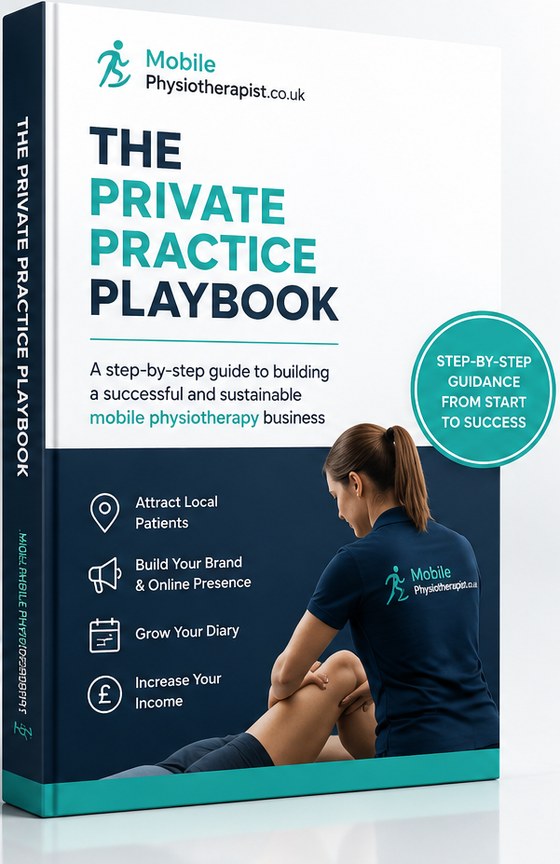
Everything you need to build a private practice, on your terms
This guide is the skeleton of our course, The Private Practice Playbook: ten modules that walk you through every step above in order, with the calculators, templates and AI prompts built into the pages, and a launch gate at the end of module 7.
The Private Practice Playbook is 26,000 words of UK-specific, step-by-step guidance from the team behind a home-visit network of physiotherapists across England and Wales. Our real prices, our real numbers, and the mistakes we have already made so you do not have to.
- Proven strategies. Attract local patients and build the referral relationships that keep a diary full.
- Practical tools and templates. Calculators, checklists, letters and AI prompts, already written for you.
- Price and earn properly. What to charge, how to say it out loud, and the honest maths behind a private week.
- Flexible and self-paced. Read it in an evening, then work through it one module at a time.
Read the first two modules free Is your county free?
Ten modules, yours for a one-off £75. No subscription. Take a county listing with our network and the course is included, with the £75 coming off your first invoice.