Physiotherapy insurance in the UK: what a self-employed physio actually needs
Published • 5 min read
Written by the team at Mobile Physiotherapist, for physiotherapists
If you are a patient wondering whether your health insurance pays for physiotherapy, you want this article instead. This one is for physiotherapists: the cover you need before you treat anyone privately, in plain English.
The short version
A self-employed physiotherapist in the UK needs, at minimum: professional liability insurance (often called professional indemnity or PLI), public liability, and business use on their motor policy if they travel to patients. You need to pay the ICO data protection fee, which is not insurance but is compulsory. If you ever take someone on, even part time, you need employers' liability by law. Everything else is optional.
1. Professional liability insurance (PLI)
This is the one that matters most. It covers claims that your clinical advice or treatment caused harm. The HCPC requires every registrant to have a professional indemnity arrangement in place as a condition of registration, so this is not optional and never has been.
If you are a full member of the Chartered Society of Physiotherapy, PLI is included in your membership for your own practice as an individual. That covers the vast majority of physios going private as sole traders. Check the current scope and limits on the CSP website rather than relying on what a colleague remembers; the wording changes from time to time.
The catch that surprises people: the CSP scheme covers you, the individual member. It does not cover a limited company as an entity. If you trade through a company, the company can be sued in its own right and needs its own policy. This is why we tell physios the sole trader versus limited company decision is partly an insurance decision, not just a tax one.
If you are not a CSP member, several specialist healthcare insurers and brokers offer physiotherapy PLI, usually bundled with public liability, for roughly £100 to £300 a year depending on turnover and what you do. Get two quotes and read the exclusions: acupuncture, dry needling, hydrotherapy, paediatrics and any product sales are the usual ones that need declaring.
2. Public liability
PLI covers your clinical judgement; public liability covers everything else that can go wrong around a person or their property. The patient trips over your couch bag. You knock a lamp off a table. A relative slips on the wet floor you did not notice. In a home-visit practice you are working in other people's houses all day, so this is not theoretical. It is often included in the same policy as PLI. Check the limit; £1 million to £5 million is typical, and some care homes and case management companies specify a minimum before they will refer to you.
3. Motor insurance: business use
Driving to patients is business travel, and a standard "social, domestic and pleasure, including commuting" policy does not cover it. You need Class 1 business use, which for most people is a small premium change. If you do not declare it and have an accident on the way to a visit, the insurer can refuse the claim. Tell them, get it in writing, and keep a simple mileage log while you are at it: from 6 April 2026 HMRC's simplified mileage rate is 55p a mile for the first 10,000 business miles in the tax year and 25p after that, which is a deduction from your taxable profit, not money you receive.
4. Employers' liability
The moment you employ anyone, including a part-time administrator or a physio working under your direction, the Employers' Liability (Compulsory Insurance) Act requires cover of at least £5 million, and the certificate must be displayed or available. Self-employed associates working under their own insurance are a grey area that depends on how the relationship actually works, not what the contract calls it; if you build a team, that is a conversation to have with your insurer and an accountant before the first associate starts, and it is one of the traps we walk through in the team-building module of our course.
5. The ICO fee (not insurance, but compulsory)
Holding patient records means you are a data controller, and unless you are exempt, which a private practice will not be, you must pay the data protection fee to the Information Commissioner's Office. For a small practice it is £52 a year, or £47 by direct debit, and you can register online in ten minutes. Not paying is a fixed penalty offence. You will also need a privacy notice; the ICO has a free generator that produces a perfectly good one for a sole practitioner.
Optional cover worth considering
- Equipment cover. A portable couch, a laptop and a phone in a car that gets broken into. Some home contents policies extend to business equipment; most do not.
- Legal expenses. Covers legal costs in a dispute with a patient, supplier or HMRC. Often cheap as an add-on.
- Income protection. The employer sick pay you are giving up. Worth pricing once your private income is something you rely on.
- Cyber insurance. Only really relevant once you have a website that takes bookings or a team sharing records. For a sole trader with good backups, the money is better spent on the backups.
Turn it into a marketing asset
Once it is in place, say so. "HCPC registered, fully insured, Enhanced DBS checked" on your website, your Google profile and your referral letter answers the question a case manager or a worried daughter is silently asking. People do not choose the cheapest home-visit physio; they choose the one who looks like they will not go wrong.
A checklist before your first private patient
- PLI in force in your own name (and in the company's name if you have one)
- Public liability limit that meets your referrers' requirements
- Business use added to your motor policy, confirmed in writing
- ICO fee paid and privacy notice written
- Renewal dates in your calendar, a month ahead
Keep the policy documents in one folder you can email from your phone. You will be asked for them by a care home at some point, and being able to send them within the hour is exactly the kind of small thing that wins the referral.
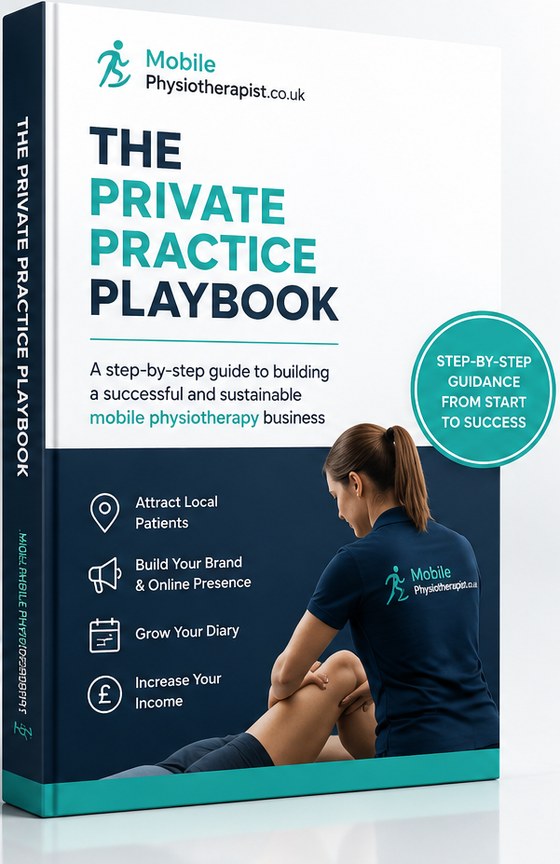
Everything you need to build a private practice, on your terms
Module 7 of our course, Making it official, turns this into a week of small tasks with a checklist that remembers your ticks, and ends with a launch gate so you know the moment you are safe to book the first patient.
The Private Practice Playbook is 26,000 words of UK-specific, step-by-step guidance from the team behind a home-visit network of physiotherapists across England and Wales. Our real prices, our real numbers, and the mistakes we have already made so you do not have to.
- Proven strategies. Attract local patients and build the referral relationships that keep a diary full.
- Practical tools and templates. Calculators, checklists, letters and AI prompts, already written for you.
- Price and earn properly. What to charge, how to say it out loud, and the honest maths behind a private week.
- Flexible and self-paced. Read it in an evening, then work through it one module at a time.
Read the first two modules free Is your county free?
Ten modules, yours for a one-off £75. No subscription. Take a county listing with our network and the course is included, with the £75 coming off your first invoice.