Employed, locum or self-employed physio? An honest comparison for UK physiotherapists
Published • 5 min read
Written by the team at Mobile Physiotherapist, for physiotherapists
Most physiotherapists do not choose one of these for life. They move between them, and increasingly they combine them. Here is what each really involves in 2026, so you can choose the mix on purpose rather than by accident.
The three options in one table
| Employed (NHS or private provider) | Locum (agency or bank) | Self-employed (own practice) | |
|---|---|---|---|
| Income | Fixed by band; predictable | Hourly or daily rate, usually above the equivalent band | Set by you; variable, especially early on |
| Security | High | Low; contracts end | Depends on your caseload and referrers |
| Pension | Employer contributes | Sometimes, via umbrella or NHS bank | Only what you put in |
| Sick pay and holiday | Yes | Rarely, or rolled into the rate | No |
| Control of caseload | Low | Low to medium | High |
| Admin burden | Low | Medium (timesheets, compliance, IR35) | High (everything) |
| Insurance | Employer's vicarious liability, plus your own PLI | Usually your own PLI required | Your own PLI, public liability, business motor |
| Tax | PAYE | PAYE via umbrella, or self-assessment if outside IR35 | Self Assessment; possibly a company later |
Employed: what you are actually buying
The salary is only part of it. The employer pension contribution, sick pay, maternity or paternity pay, paid CPD time, supervision, a multidisciplinary team down the corridor and someone else's governance framework are all worth real money and real peace of mind. When physios say they "took a pay cut to go private", they often mean they gave these up without pricing them. Price them. Then decide.
The cost is control. Your caseload, your hours, your location and your pace are set by the service. For a lot of people that is fine for years, then suddenly is not.
Locum: the middle road, with some potholes
Locum physiotherapy through an agency or an NHS bank pays a higher headline rate than the equivalent employed post and gives you flexibility about when and where you work. It is also the fastest way to top up income while you build a private caseload, because the shifts are there when you want them and gone when you do not.
The potholes:
- IR35 and umbrella companies. Most NHS locum roles are inside IR35, which means you are paid through an umbrella company on PAYE with employer's National Insurance and the umbrella's margin coming out of the rate. The advertised figure and the figure that reaches your bank can be quite different. Ask for a take-home illustration before you accept.
- No continuity. Contracts end, sometimes at a week's notice, and there is no redundancy pay.
- Compliance every time. Each agency wants its own DBS, references, occupational health and mandatory training, so joining the DBS Update Service saves you a lot of repetition.
- It does not build anything. Locum work pays for today. Nothing you do in a locum post is yours when it ends, whereas every patient, review and referrer in a private practice is an asset you keep.
Self-employed: what nobody tells you until you have done it
You will spend a third of your first year on things that are not physiotherapy: registrations, insurance, a Google profile, a website, replying to enquiries, invoicing, writing terms and privacy notices, a lone-working plan. None of it is hard. All of it is new, and doing it in the wrong order is what makes people give up. We set out the right order here.
The rewards are real. You choose your patch, your hours, your caseload and your price. Home-visit work in particular is a caseload of older adults, post-operative rehab and neurological conditions where you have time with the patient and see the change. And the income, at a sensible price and four visits a day, is comparable with a senior employed post; we did the numbers properly here.
The risks: variable income while the caseload builds, no sick pay, and the loneliness of being the whole service. Mitigate them by keeping a paid job or locum shifts while you start, keeping three months' costs in reserve, and finding one or two other private physios to talk to. A network like ours exists partly for that reason.
The portfolio route most physios actually take
In practice the common path looks like this: keep the employed post at three or four days a week (with written permission for private work), see private patients one day and some evenings, and after six to twelve months either drop a day at work or stop. Locum shifts fill the gap if the private diary has a slow month. The employed post keeps the pension and the sick pay while the private work proves itself, and you find out whether you like running a business before you depend on it.
Two things to check before you start the portfolio: your employment contract's secondary work clause, and that your professional liability insurance covers private practice as well as employed work (CSP membership does, for you as an individual).
How to decide
- If you value predictability above control, stay employed and do not feel bad about it.
- If you want flexibility now and are not ready to build something, locum, but go in with a take-home illustration and the DBS Update Service.
- If you want a caseload and a diary that are yours, start self-employed alongside your job, in the right order, and give it a year.
There is no wrong answer here, only an unexamined one. The physios who regret going private are almost always the ones who did it without the maths, the governance or a plan for the slow first months. The ones who regret staying employed are the ones who never ran the numbers at all.
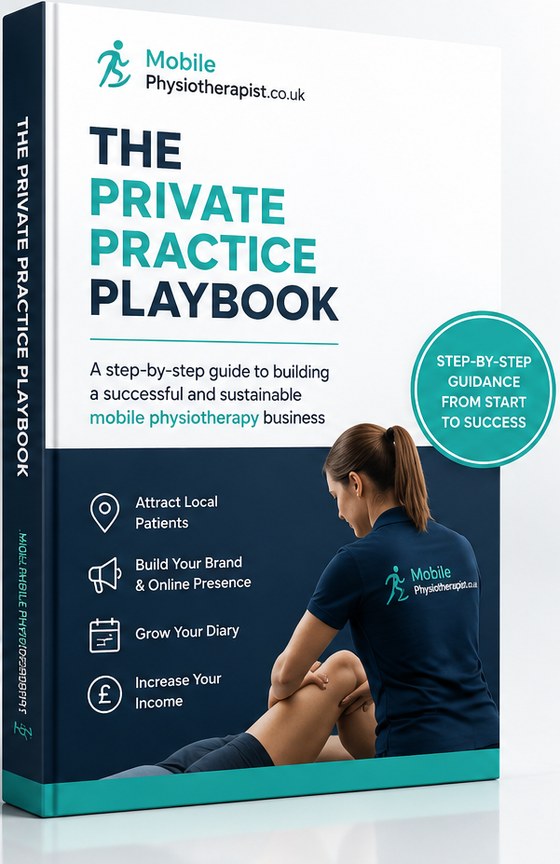
Everything you need to build a private practice, on your terms
If you are leaning towards the self-employed or portfolio route, our course starts with the honest maths and the decision itself, before any of the paperwork. The first two modules are free to read.
The Private Practice Playbook is 26,000 words of UK-specific, step-by-step guidance from the team behind a home-visit network of physiotherapists across England and Wales. Our real prices, our real numbers, and the mistakes we have already made so you do not have to.
- Proven strategies. Attract local patients and build the referral relationships that keep a diary full.
- Practical tools and templates. Calculators, checklists, letters and AI prompts, already written for you.
- Price and earn properly. What to charge, how to say it out loud, and the honest maths behind a private week.
- Flexible and self-paced. Read it in an evening, then work through it one module at a time.
Read the first two modules free Is your county free?
Ten modules, yours for a one-off £75. No subscription. Take a county listing with our network and the course is included, with the £75 coming off your first invoice.