Physiotherapy CPD courses in the UK: the business skills nobody teaches you
Published • 5 min read
Written by the team at Mobile Physiotherapist, for physiotherapists
Physiotherapists are good at clinical CPD. Courses on the shoulder, the neuro patient, the paediatric hip: the market is full of them and most physios do more than they need to. The CPD almost nobody does is the kind that lets you run a safe, sustainable private practice. That counts too.
What the HCPC actually requires
The HCPC's CPD standards ask every registrant to keep a continuous, up-to-date and accurate record of their CPD; to make sure it is a mixture of learning activities relevant to current or future practice; to show it has contributed to the quality of their practice and service delivery; to show it benefits service users; and to present a written profile if selected for audit at renewal (a random sample of registrants is asked each renewal cycle). There is no minimum number of hours and no list of approved courses. What matters is relevance and reflection.
Two words in there are the ones physios miss: future practice. If you plan to work privately, learning how to price, consent, keep records, safeguard and market a private service is CPD by the HCPC's own definition, and it benefits service users directly, because a practice with proper governance is a safer one.
Types of CPD that count
The HCPC groups activities as work-based learning, professional activity, formal education and self-directed learning. In practice that means all of the following, provided you record them and reflect on them:
- Formal courses and conferences, online or in person
- In-service training, case discussion and peer review
- Reading journals and guidelines, and writing up what changed as a result
- Supervising or mentoring others
- Audit, service development and, yes, learning to run a practice
- Reflective practice on your own cases
The record does not need to be elaborate. A running document with the date, the activity, what you learned and how it changed your practice is exactly what the audit asks for.
Free physiotherapy CPD worth your time
- The CSP runs regular free webinars for members and its professional networks (older people, neurology, paediatrics and so on) each have their own programmes.
- NHS e-Learning for Healthcare has free modules on safeguarding, information governance, infection control and dementia awareness, many of which are also the mandatory training a care home or case manager will ask whether you have done.
- NICE guidance updates, read critically and written up, are CPD.
- Journal clubs, formal or a WhatsApp group of three colleagues who read the same paper once a month.
- The ICO and HCPC themselves publish guidance on records, consent and confidentiality that every private physio should have read and can legitimately log.
Paid clinical CPD: how to choose
The market is large and quality varies. Before paying for a clinical course, ask: does it change what I will do on Monday? Is it delivered by someone who currently treats patients? Does it come with something I keep (manuals, exercise resources, a community)? And is the topic one my caseload actually needs? A mobile physio seeing older adults gets more from a good falls, frailty or post-operative course than from a sports taping weekend, however much fun the weekend is.
The CPD gap: running the practice
Here is the uncomfortable truth. A physiotherapy degree teaches you nothing about pricing, consent forms, privacy notices, lone working, complaints handling, Google, reviews, referral letters, invoicing, tax or employment status. Every one of those is something a private physio does every week, and every one of them can go wrong in ways that hurt patients and end careers. Learning them properly is CPD. It is also, unlike most clinical courses, CPD that pays for itself in the first month.
What good practice-management CPD covers:
- Clinical governance for a solo practitioner: consent separate from data protection, records, safeguarding routes in your nation, lone working, incidents, complaints, continuity if you are ill
- The regulatory basics: HCPC, insurance, DBS and the Update Service, the ICO fee, motor business use
- Money: pricing, Self Assessment, what to reserve for tax, mileage, when a limited company makes sense, the VAT position of physiotherapy
- Marketing that is legal and works: Google Business Profile, a review routine that does not filter, a simple website, referral relationships
- Using AI safely: what is fine (business writing), what needs an approved clinical tool with a contract behind it (anything about a patient), and what is never acceptable
- Growing beyond yourself: associates, employment status, insurance and the questions to ask an accountant before the first one starts
Whether you learn this from a mentor, a course, or expensive experience is your choice. We built The Private Practice Playbook because the physios joining our network were learning it the expensive way, one at a time, and we were answering the same twenty questions by email. The first two modules are free; the rest is a one-off £75 or included with a county listing. Log the time you spend on it, reflect on what changed, and it is CPD like any other.
How to write it up
For any activity, clinical or business, the reflection that satisfies an HCPC audit is short:
- What did I do, and when?
- What did I learn?
- How has, or will, my practice change as a result?
- How does that benefit the people I treat?
"Completed a practice-governance course; wrote a lone-working procedure and a separate consent form and privacy notice; patients now receive written information before the first visit and I have a check-in contact for every home visit" is a perfectly good CPD entry. Better, arguably, than another shoulder course.
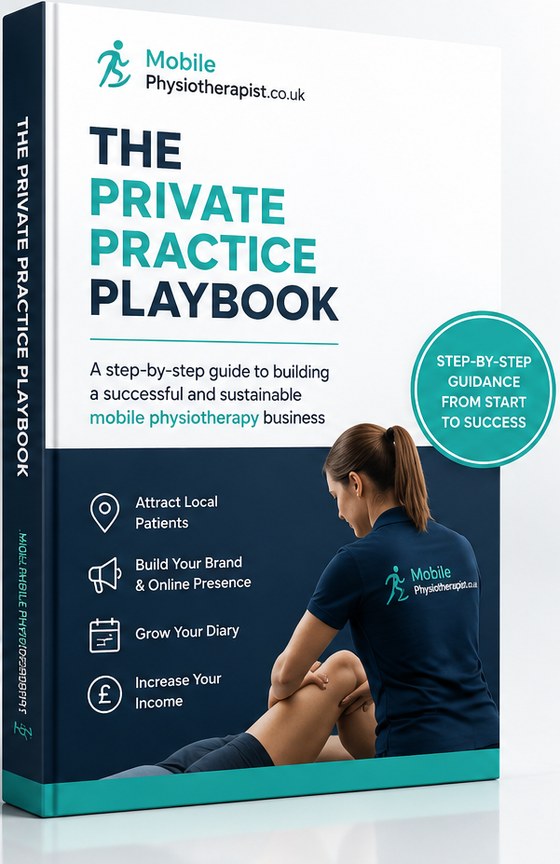
Everything you need to build a private practice, on your terms
The Private Practice Playbook is practice-management CPD written by a working home-visit network: ten modules, working tools on every page, and a change log so you can see when a rule moved.
The Private Practice Playbook is 26,000 words of UK-specific, step-by-step guidance from the team behind a home-visit network of physiotherapists across England and Wales. Our real prices, our real numbers, and the mistakes we have already made so you do not have to.
- Proven strategies. Attract local patients and build the referral relationships that keep a diary full.
- Practical tools and templates. Calculators, checklists, letters and AI prompts, already written for you.
- Price and earn properly. What to charge, how to say it out loud, and the honest maths behind a private week.
- Flexible and self-paced. Read it in an evening, then work through it one module at a time.
Read the first two modules free Is your county free?
Ten modules, yours for a one-off £75. No subscription. Take a county listing with our network and the course is included, with the £75 coming off your first invoice.