Falls in the Older Adult: A Leicestershire Physio's Approach to Berg Balance and FRAT Assessment
Published · 10 min read
Local Physiotherapist — Jay Singh, Leicestershire
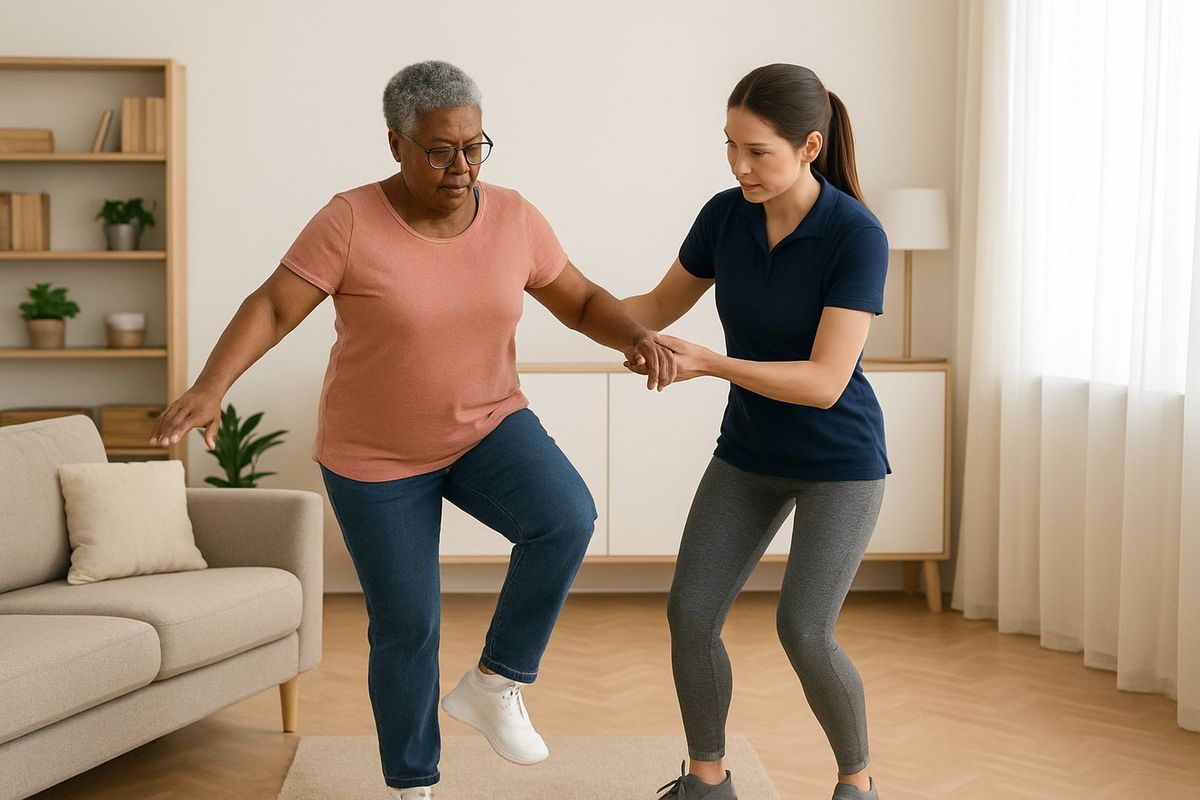
Falls in older adults are common, costly and largely preventable. The single most useful thing a physiotherapist can do is a thorough, validated falls assessment in the home where the falls actually happen. Here's exactly what that looks like across Leicestershire — the tools Jay uses, what they reveal, and how the results turn into a plan that actually changes risk.
Why a home assessment, not a clinic one?
Falls happen in real environments — your stairs, your bathroom, the route to the kettle, the rug at the bottom of the bed. A clinic-based balance assessment can show how someone performs on a flat, well-lit, hazard-free floor with a physio watching. That's useful, but it's not where most falls happen.
A home falls assessment reveals the actual hazards, captures a real-life sit-to-stand from the actual chair you spend most of the day in, and traces the night-time route to the toilet. That's where prevention work happens.
The validated tools Jay uses
These are the same assessments used in NHS community falls services — the difference is having time to do them properly, in your home, with no rush.
FRAT — Falls Risk Assessment Tool
FRAT is a quick screening tool that scores you on factors like: history of falls in the last year, polypharmacy (5+ medications), psychological status (anxiety/depression), cognitive status, and balance. It gives a low/medium/high risk score that frames the rest of the assessment.
Berg Balance Scale
The Berg is the gold-standard balance assessment, scoring 14 functional balance tasks (sit-to-stand, transfers, turning 360 degrees, single-leg stance, etc.) out of 56. A score below 45 is associated with increased falls risk; below 36 indicates a 100% risk of falls. It's sensitive to change, so it's also a great way to track progress.
Tinetti Performance-Oriented Mobility Assessment (POMA)
Tinetti combines balance and gait into one composite score. It picks up gait abnormalities (step length, stride symmetry, path deviation, trunk control during walking) that the Berg doesn't capture as well. A Tinetti score below 19 indicates high falls risk.
Timed Up & Go (TUG)
TUG measures the time to stand from a chair, walk 3 metres, turn, walk back, and sit down. Over 13.5 seconds is a falls-risk threshold. It's quick, repeatable, and useful for tracking change session-to-session.
30-second Sit-to-Stand
A simple measure of lower-limb strength — how many sit-to-stands can you do in 30 seconds? Reference values exist by age group, so it's quickly clear whether your strength is in the normal range or significantly below.
Beyond the score: what the assessment actually changes
Numbers are useful but the real product of a falls assessment is a plan. After a typical first visit, the patient (and family, where involved) gets:
- A clear picture of which falls-risk factors apply to them — not generic advice
- A targeted strength-and-balance programme, usually 4–5 specific exercises (not 20)
- Home-environment recommendations, prioritised — lighting first, rugs second, bathroom rails third, etc.
- A medication conversation if polypharmacy or postural hypotension looks like a factor (in liaison with the GP if needed)
- A written summary they can share with family or the GP
- A follow-up plan — typically 4–6 visits over 8–10 weeks, then re-assessment
The intervention that actually moves the needle
The evidence on falls prevention is unusually clear: the things that work are progressive strength-and-balance exercise and home-environment modification. The Otago Exercise Programme is the gold-standard structure for this, and it's what Jay bases most of his home falls work on, individualised to the person.
What doesn't work as well as people think:
- Walking alone — walking is great but it doesn't progressively challenge balance enough to reduce falls
- Generic “seated exercises” sheets — not specific enough, not progressive enough
- Hip protectors — useful for some but compliance is poor
- Tai chi by DVD — the live, instructed version helps; the home video version less reliably
What about post-fall confidence?
One of the most under-treated parts of falls is the psychological side. After a fall, many people develop “fear of falling” — they avoid activity, avoid going out, and the deconditioning makes the next fall more likely. This is a vicious cycle and it needs explicit addressing in any falls plan.
Jay uses the Falls Efficacy Scale (FES) to track confidence over time. It's often the score that changes most dramatically with rehab — strength might double, but confidence to walk to the corner shop on your own can be the bigger life change.
Care home and supported living residents
Jay sees a steady caseload of falls assessments in care home and extra-care settings across Leicestershire too. The same tools apply, but with extra emphasis on staff training, transfer techniques and equipment review. If you manage a home and want a focused falls audit for a high-risk resident, get in touch.
Where Jay covers
- Falls prevention in Leicester
- Falls prevention in Loughborough
- Falls prevention in Hinckley
- Falls prevention in Melton Mowbray
- Falls prevention in Market Harborough
- Falls prevention in Coalville
- Falls prevention in Oadby
- Falls prevention in Wigston
Or browse the full Leicestershire falls prevention hub.
Worth a free call?
If a relative has had a fall in the last year, is afraid of falling, or you're noticing they avoid stairs or going outside — it's worth a free phone call. The earlier the assessment, the more there is to work with.
Related guides
- Falls prevention in Leicestershire
- 5 exercises to prevent falls in older adults
- Balance exercises for seniors at home
- Fear of falling: how to overcome anxiety
- Home hazards that cause falls

About Jay Singh
Jay Singh is a Senior Physiotherapist with 10+ years' NHS experience across acute, community, stroke, MSK, respiratory, and neurological rehabilitation. Currently working as a Senior Locum Physio across the East Midlands, Jay provides expert home visit physiotherapy across Leicestershire. He is HCPC registered (PH104786).