Pregnancy-Related Back and Pelvic Pain: Physiotherapy at Home in Lincolnshire
Published
Local Physiotherapist — Rachel Butt, South Lincolnshire
Back and pelvic pain in pregnancy is extremely common and still routinely dismissed as something to put up with. It is not. It responds well to treatment, and the sooner it is dealt with the less it tends to interfere with the rest of the pregnancy.
What is actually going on
Pelvic girdle pain is felt at the front of the pelvis over the pubic bone, or at the back over one or both sacroiliac joints, and often spreads into the buttock or thigh. Pregnancy-related low back pain sits higher and behaves more like ordinary back pain.
Both are driven by a combination of things happening at once: a rapidly changing centre of gravity, increased load through the pelvis, hormonal changes affecting ligament stiffness, and the deep abdominal and pelvic floor muscles working in a body shape that keeps changing. It is a mechanical problem in an unusually fast-moving situation, not damage.
What it typically feels like
- Pain turning over in bed, which is often the first and most disruptive symptom
- Pain getting in and out of a car, or standing on one leg to dress
- A grinding or clicking sensation at the front of the pelvis
- Pain walking, particularly after a certain distance, and worse by the end of the day
- Difficulty with stairs, or with pushing a trolley or pram
What treatment involves
Assessment first: which structures are actually provoked, how far you can go before symptoms come on, and which daily activities are driving it. From there, treatment is usually a combination of:
- Hands-on treatment to settle the painful joints and the muscles guarding around them
- Specific strengthening for the deep abdominal, gluteal and pelvic floor muscles that support the pelvis under load
- Movement retraining for the exact tasks that hurt — a different way of getting out of bed, of getting into the car, of managing the stairs
- Support belts where they help, fitted properly rather than bought on guesswork
- Pacing advice, because the commonest pattern is a good day followed by too much activity followed by two bad ones
Practical things that help straight away
- Keep the knees together when turning in bed and when getting in and out of a car — that one change often makes the biggest single difference
- Sit down to dress rather than standing on one leg
- Take stairs one at a time if it hurts, leading with the less painful leg
- A pillow between the knees at night, and one supporting the bump
- Break up walking into shorter stretches rather than one long one
- Avoid heavy shopping carried on one side
Why home visits suit pregnancy particularly well
By the third trimester, travelling to an appointment is often the least appealing part of the week, and sitting in a car for half an hour across a rural county is exactly the position that provokes pelvic girdle pain. A home visit removes that entirely.
It also means the advice is specific. The bed you actually have to turn over in, the sofa you have to get out of, the stairs you climb ten times a day — all of that can be worked on directly rather than described.
After the birth
Pelvic girdle pain usually improves substantially after delivery, but not always immediately, and the postnatal period brings its own loads: feeding positions, carrying a car seat, lifting from a cot. Rehabilitation afterwards is worth doing properly rather than waiting to see whether it settles by itself.
Anything involving bladder, bowel or internal pelvic floor assessment is the province of a specialist pelvic health physiotherapist, and where that is the right route the honest answer is to say so and point you to one.
Who you would be seeing
Rachel Butt sought out extra training with the pelvic health physiotherapists during her NHS Band 6 post, which made her one of a small number of musculoskeletal physiotherapists treating pregnancy-related MSK pain. It remains part of her caseload.
Home visits across Lincolnshire
Treatment for pregnancy-related back and pelvic pain is available at home across Stamford, Grantham, Bourne, Spalding, Sleaford, Boston and the rest of south Lincolnshire. For Lincoln and the north of the county, Olu Faleye visits people at home.
Book a home visit in Lincolnshire
A free phone enquiry is the easiest place to start — talk through what is going on and check whether home physiotherapy is the right fit. No GP referral is needed.
Please mention Mobile Physiotherapist.co.uk
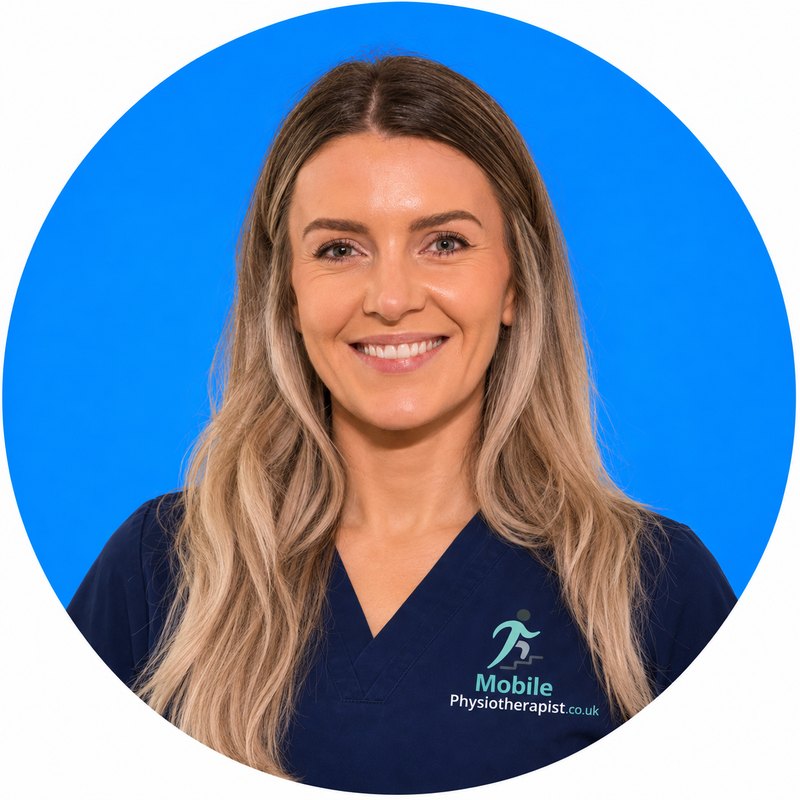
About Rachel Butt
Rachel Butt is a chartered physiotherapist (MCSP, HCPC PH113364) providing home visit physiotherapy across Stamford, Grantham, Bourne, Spalding, Sleaford, Boston and the rest of south Lincolnshire, and runs an independent practice, Stamford Physiotherapy. She qualified from the University of Birmingham in 2017 and spent four years in NHS musculoskeletal outpatient services, reaching Band 6, before moving into private practice. Her work covers back pain and sciatica, sports injuries, post-operative recovery, arthritis and persistent pain. She assesses and diagnoses directly, so there is no wait for a GP referral before treatment can start.
Read Rachel's profile or call 07376 795289.
Please mention Mobile Physiotherapist.co.uk when you call.