Knee Replacement Recovery at Home in Barnsley & Rotherham
Published
Local Physiotherapist — Hamoodi Othman, South Yorkshire
Total knee replacement is a life-changing operation for people with severe arthritis — but the recovery is often harder than patients expect. Range of movement, swelling, and pain management all matter in the first 12 weeks, and consistent home physiotherapy is the single biggest factor in a strong outcome.
Why home physio after knee replacement?
Knee replacement rehab is more demanding than hip replacement rehab. Patients need to push their knee bend (flexion) and straightening (extension) every day, manage significant swelling, and rebuild quadriceps strength that has often been weak for years before surgery. Travelling to a clinic on crutches, with a swollen knee, is exhausting and often counter-productive in the early weeks.
Home physiotherapy with Hamoodi Othman lets the assessment and treatment happen in the place that matters: your living room, your stairs, your bathroom, and your front door.
Range of movement targets
These are typical (not absolute) goals — your surgeon or physio may give you slightly different targets:
- By 2 weeks: 0° extension (knee fully straight) and around 90° flexion.
- By 6 weeks: 0° extension and 105–115° flexion.
- By 12 weeks: 0° extension and 115–125° flexion.
- Long term: Most patients achieve 110–125° of bend, enough for stairs, cycling, and most daily activities.
Week-by-week recovery
Week 1–2: Pain, swelling and getting moving
- Ice, elevation and gentle compression to control swelling.
- Quad sets, heel slides, ankle pumps and short straight-leg raises.
- Walking with crutches or a frame, focusing on a normal walking pattern.
- Stairs (often "good leg up, bad leg down" with the rail).
Week 3–6: Range of movement and strength
- Daily knee bend and straightening practice — the most important rehab task.
- Mini squats, step-ups, sit-to-stand from increasingly low chairs.
- Walking distance increases, often progressing to one crutch.
- Gentle exercise bike if range allows.
Week 6–12: Functional return
- Walking without aids around the home and outdoors.
- Stairs reciprocally (one step at a time without the rail).
- Strength work for quads, glutes, hamstrings and calves.
- Driving (typically 6–8 weeks, surgeon approval).
- Return to gentle hobbies: walking groups, light gardening, swimming.
3–12 months: Long-term recovery
Knee replacements continue to improve for up to a year. Strength and confidence build gradually, and most patients return to walking, cycling, golf, doubles tennis, and swimming. Running and high-impact sport are usually discouraged to protect the prosthesis.
After discharge from local hospitals
If your knee replacement was performed at Barnsley Hospital, Rotherham Hospital, the Northern General, the Royal Hallamshire, Doncaster Royal Infirmary, or a private hospital like Claremont, Thornbury, or Park Hill, Hamoodi can integrate the hospital exercise sheet and discharge advice into a structured home programme.
What's covered in a home visit
- Knee range-of-movement measurement and progression plan.
- Pain and swelling management strategies.
- Quadriceps and lower-limb strength work.
- Walking re-education indoors and outdoors.
- Stairs, kerbs and uneven ground practice.
- Equipment advice and home setup tweaks.
Areas covered for knee replacement rehab
- Knee replacement rehab in Barnsley
- Knee replacement rehab in Rotherham
- Knee replacement rehab in Sheffield
- Knee replacement rehab in Doncaster
- Wombwell, Wickersley, Penistone and surrounding villages
Related reading
- Hip replacement recovery at home in Sheffield
- Orthopaedic rehabilitation in South Yorkshire
- Post-operative rehabilitation in South Yorkshire
Book a free phone enquiry
Call 07821 402 634 Email Hamoodi
Please mention Mobile Physiotherapist.co.uk when you call.
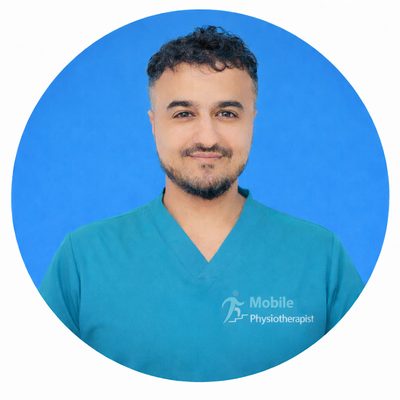
About Hamoodi Othman
Hamoodi Othman is a Senior Physiotherapist (HCPC PH131379) specialising in orthopaedic rehabilitation, post-operative recovery, and trauma rehabilitation. He has NHS experience at Sheffield Teaching Hospitals, Barnsley Hospital, and Rotherham Doncaster & South Humber NHS, and provides home physiotherapy across South Yorkshire.