Hip Replacement Recovery at Home in Sheffield
Published
Local Physiotherapist — Hamoodi Othman, South Yorkshire
A total hip replacement is one of the most successful operations in modern medicine, but the speed and quality of recovery depends almost entirely on the rehabilitation that follows. This guide explains what to expect from home physiotherapy after a hip replacement in Sheffield, including discharge from the Northern General Hospital and the Royal Hallamshire.
Why home physiotherapy after a hip replacement?
NHS discharge times after hip replacement have shortened significantly. Most patients are now sent home within 1–3 days of surgery. Outpatient appointments may be limited or spaced out, and travelling to a clinic when you are still using crutches and managing post-op pain can be exhausting.
Home physiotherapy with Hamoodi Othman, a Senior Physiotherapist with NHS orthopaedic experience at Sheffield Teaching Hospitals, lets you progress your rehab in the environment where you actually live: your stairs, your chair, your bed, your bathroom, and the routes you walk every day.
Week-by-week recovery
Week 1–2: Protection and early mobility
- Hip precautions: Avoid bending the hip past 90 degrees, crossing the legs, or twisting on the operated leg (your surgeon will confirm the exact precautions).
- Walking: Short, frequent walks with crutches or a frame, focusing on quality of movement rather than distance.
- Bed exercises: Ankle pumps, gluteal squeezes, quad sets, and gentle hip flexion within precaution limits.
- Wound care and pain management: Following hospital advice and reporting any concerns.
Week 3–6: Building strength and confidence
- Progressing from two crutches to one, then to a stick.
- Stairs practice, sit-to-stand, transfers in and out of the car.
- Adding hip abduction, mini squats, and standing balance work.
- Gradual return to light household tasks.
Week 6–12: Restoring full function
- Most hip precautions are lifted around the 6–12 week mark.
- Walking longer distances, often without aids.
- Stair confidence, kerbs, slopes, and uneven ground.
- Strength work for hip, thigh, and core muscles.
- Driving (typically 6–8 weeks, surgeon approval).
3–6 months: Return to activity
Most patients return to walking groups, gentle gardening, swimming, golf and cycling. High-impact activities like running are usually discouraged long term to protect the prosthesis.
After discharge from Sheffield hospitals
If your operation took place at the Northern General Hospital, the Royal Hallamshire Hospital, the Claremont Hospital, or Thornbury Hospital (BMI), Hamoodi can collect your hospital exercise sheet and discharge letter at the first home visit and build on the plan you have already started. He will not duplicate or contradict NHS or consultant advice — instead, the goal is to add structure, frequency, and progression at home.
What's covered in a home visit
- Assessment of pain, range of movement, strength and gait.
- Review of hip precautions and a clear, written exercise programme.
- Stairs and transfer practice in your own home.
- Walking re-education indoors and outdoors.
- Equipment advice (perching stools, raised toilet seats, sock aids, grab rails).
- Liaison with your GP, consultant, or NHS physio if helpful.
Areas covered for hip replacement rehab
Hamoodi provides home physiotherapy after hip replacement across Sheffield and the wider region:
- Hip & knee replacement rehab in Sheffield
- Hip & knee replacement rehab in Rotherham
- Hip & knee replacement rehab in Barnsley
- Hip & knee replacement rehab in Doncaster
- Chapeltown, Stocksbridge, Penistone and surrounding villages
Related reading
- Hip and knee replacement rehab at home in Sheffield & Barnsley
- Orthopaedic rehabilitation in South Yorkshire
- Post-operative rehabilitation in South Yorkshire
Book a free phone enquiry
If you have a hip replacement coming up, or have just been discharged, start with a free phone call to discuss your needs.
Call 07821 402 634 Email Hamoodi
Please mention Mobile Physiotherapist.co.uk when you call.
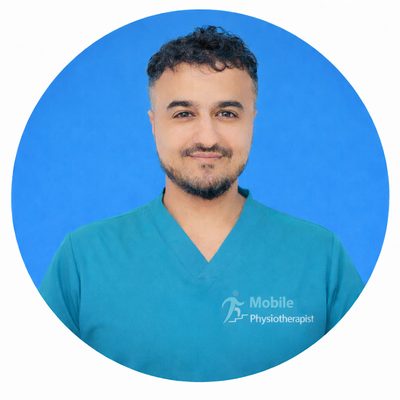
About Hamoodi Othman
Hamoodi Othman is a Senior Physiotherapist (HCPC PH131379) with NHS experience at Sheffield Teaching Hospitals, Barnsley Hospital, and Rotherham Doncaster & South Humber NHS. He specialises in orthopaedic rehabilitation, post-operative recovery, and trauma rehabilitation, and provides home physiotherapy across South Yorkshire.