Jaw Clenching, Teeth Grinding and TMJ Pain: Physiotherapy in Gloucestershire
Published
Local Physiotherapists — Rajan Kurian and the My Rehab at Home team, Gloucestershire
Lots of people clench their teeth without knowing it: while driving, while working at a screen, or in their sleep. Over time that can leave the jaw sore, stiff and clicking, and bring on headaches. Doctors call this a TMJ problem, and physiotherapy is one of the main ways to treat it.
The jaw joint in a nutshell
You have a jaw joint on each side of your face, just in front of your ears. Put your fingers there and open your mouth, and you can feel it move. Its proper name is the temporomandibular joint, or TMJ. Strong chewing muscles at the side of the face and at the temples move it.
When those muscles are overworked, or the joint is not moving smoothly, the result is pain and stiffness. Most of the time it is the muscles, not the joint itself.
Signs it might be your jaw
- An aching jaw or face, often worst first thing in the morning
- Pain in front of the ear, or an earache when the ear itself is fine
- Clicking or popping when you open your mouth or chew
- A jaw that catches, or gets stuck for a moment
- Finding it hard to open wide, or to bite into an apple
- Headaches at the temples
- A tired jaw after chewing, and a stiff neck and shoulders
Why clenching matters
At rest, your teeth should not touch. The jaw muscles are meant to switch off. Many of us clench when we concentrate, feel stressed or sleep, and the muscles never get their rest. They get tired and sore, just like any muscle that is worked all day.
The resting position to aim for is simple: lips together, teeth apart, tongue resting gently on the roof of the mouth.
Other things that can play a part
- Grinding your teeth at night
- Stress, worry and poor sleep
- Chewing gum, biting your nails or chewing pens
- Lots of hard or very chewy food
- Sitting with your head pushed forward, for example at a laptop
- A long time with your mouth wide open at the dentist
- A knock to the jaw, or arthritis in the joint
Things you can try today
- Catch yourself clenching. Put a small sticker on your computer, phone or car dashboard. Each time you see it, check your jaw and let it relax.
- Use the resting position above, many times a day.
- Go soft for a week or two. Soup, pasta, fish, eggs. Cut food into small pieces and chew on both sides.
- Stop chewing gum.
- Do not open too wide. Support your chin with your hand when you yawn.
- Warmth on the sore muscles for ten minutes can ease them.
How physiotherapy helps
Assessment. The physiotherapist looks at how far you can open, which way the jaw moves, where it clicks, and which muscles are tight and tender. They will check your neck too, because neck problems and jaw problems often go together.
Hands-on treatment. Gentle massage and stretching of the chewing muscles, at the side of the face and the temples, and gentle movement of the joint. Anna is a massage therapist as well as a physiotherapist, and has a special interest in jaw problems.
Exercises. Simple, gentle exercises to help the jaw open in a straight line and move smoothly. These are done slowly in front of a mirror, often with the tongue on the roof of the mouth. They are only a few minutes a day.
Help with habits. Breathing and relaxation, sitting well, and ways to break the clenching habit.
Most people need a few visits, with exercises in between.
Is a click always a problem?
No. Many people have a jaw that clicks with no pain at all. If it does not hurt and does not get stuck, it usually needs no treatment.
Working alongside your dentist
If you grind your teeth at night, your dentist can check for wear and may make you a mouth guard. Physiotherapy and dental care work well together.
When to get help quickly
- See a dentist or doctor quickly if your jaw is locked and will not open or close, or if you have swelling, a high temperature or numbness in your face.
- Call 999 if jaw pain comes with chest pain, breathlessness or sweating. This can be a heart problem.
Jaw pain treatment across Gloucestershire
Home visits for jaw pain and TMJ problems are available across Gloucester, Cheltenham, Stroud, Cirencester, Tewkesbury, Lydney, Yate and across Gloucestershire. You can read more about jaw pain treatment in Cheltenham and TMJ physiotherapy in Gloucester.
Book a home visit in Gloucestershire
A free phone call is the easiest place to start — talk through what is going on and check whether home physiotherapy is the right fit. No GP referral is needed.
Please mention Mobile Physiotherapist.co.uk
About Raj and the My Rehab at Home team
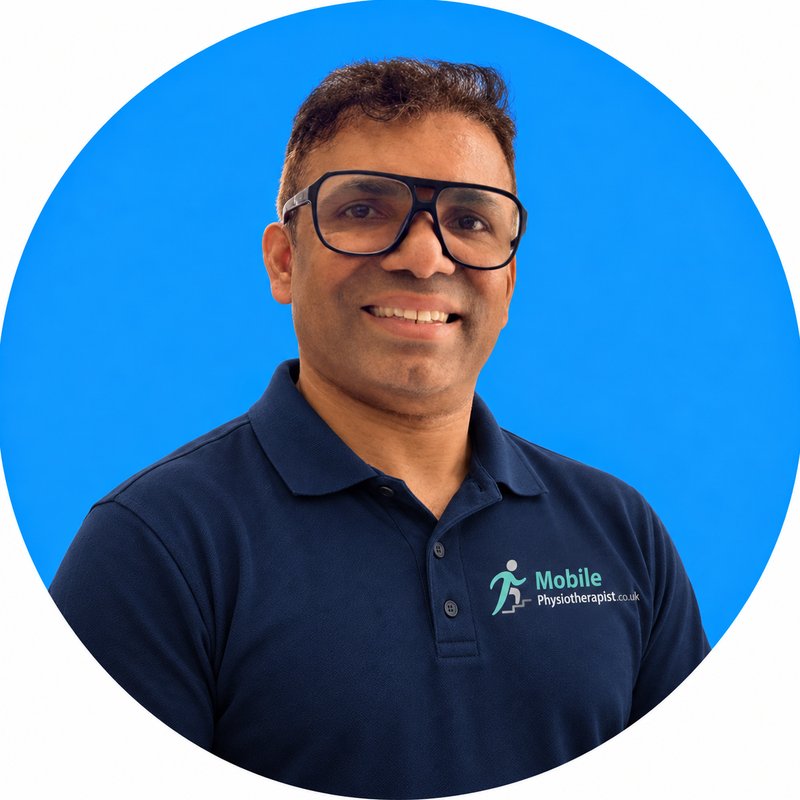
Rajan Kurian (HCPC PH113871) founded My Rehab at Home, a team of five physiotherapists who visit people at home across Gloucester, Cheltenham, Stroud, Cirencester, Tewkesbury, Lydney, Yate and across Gloucestershire. Raj also works in the NHS as a First Contact Physiotherapist in GP surgeries and a Senior Physiotherapist in local hospitals. He works with Sophie, Fliss, Anna and Katie, whose interests include falls and balance, recovery after surgery, stroke and neurological conditions, vertigo and dizziness, jaw (TMJ) problems and rehabilitation after an amputation.
Read Raj's profile or call 01594 203707.
Please mention Mobile Physiotherapist.co.uk when you call.