Choosing a Physiotherapist in Gloucestershire
Published
Local Physiotherapists — Rajan Kurian and the My Rehab at Home team, Gloucestershire
Anyone can call themselves a therapist. Only someone on the HCPC register can legally call themselves a physiotherapist. That one fact is the most useful check you have, and it takes about a minute.
Start with HCPC registration
"Physiotherapist" is a protected title in the UK. To use it, a person must be registered with the Health and Care Professions Council. That means an approved qualification, keeping to professional standards, and answering to a regulator if something goes wrong.
You can search the HCPC register for free on its website. A physiotherapist should give you their registration number straight away. If someone is vague about it, that tells you what you need to know.
What does "chartered" mean?
A chartered physiotherapist is a member of the Chartered Society of Physiotherapy, the professional body. It is not a legal must in the way HCPC registration is, but it shows they keep up with the profession.
Watch for titles that are not protected
"Sports therapist", "rehabilitation therapist", "movement specialist" and similar titles are not protected. Some people using them are well trained, but none of them comes with the same regulator behind it. If that matters to you, check for HCPC by name.
Match the experience to your problem
Physiotherapy is broad. Someone who spends their week on sports injuries is not always the right person for someone recovering from a stroke, and the other way round is just as true. Ask what they treat day to day.
- Falls and unsteadiness — ask whether they measure strength and balance, and look at the house as well as the person
- After a joint replacement or an operation — ask whether they follow the hospital's plan and build on it
- Stroke or a neurological condition — ask how much neurological rehabilitation they have done
- Dizziness — ask whether they have training in vestibular (inner ear and balance) problems
- After an amputation — ask whether they have worked with people learning to walk with a prosthetic leg
- Back, neck or joint pain that has not settled — ask how they work out the cause, and when they would send you back to your GP
A small practice with several physiotherapists can be a real help here, because the person who visits can be matched to the problem.
What should I ask on the phone?
- Are you HCPC registered, and what is your number?
- How much experience do you have with my problem?
- How long is a visit, and what does it cost?
- Do you cover my postcode, and is there a travel charge?
- Roughly how many visits do you think I will need?
- How will we know if it is working?
- Are you insured for home visits?
A good physiotherapist will answer all of these happily, and will tell you if they are not the right person for the job.
Clinic or home visit?
A clinic makes sense if you drive, the problem is not affecting how you get about, and you want gym equipment. A home visit makes sense if travelling is hard or painful, you are not driving, the problem is about managing your own house, or you care for someone and cannot get away.
What do home visits cost?
Home visits cost more than a clinic appointment, because the physiotherapist travels to you and sees fewer people in a day. For that you get an unhurried session, no travel or parking of your own, and treatment built around the place you live.
Ask for the total cost up front, including any travel charge. The prices for home visits with Raj and his team are published in full.
Home physiotherapy across Gloucestershire
Home visits are available across Gloucester, Cheltenham, Stroud, Cirencester, Tewkesbury, Lydney, Yate and across Gloucestershire.
Book a home visit in Gloucestershire
A free phone call is the easiest place to start — talk through what is going on and check whether home physiotherapy is the right fit. No GP referral is needed.
Please mention Mobile Physiotherapist.co.uk
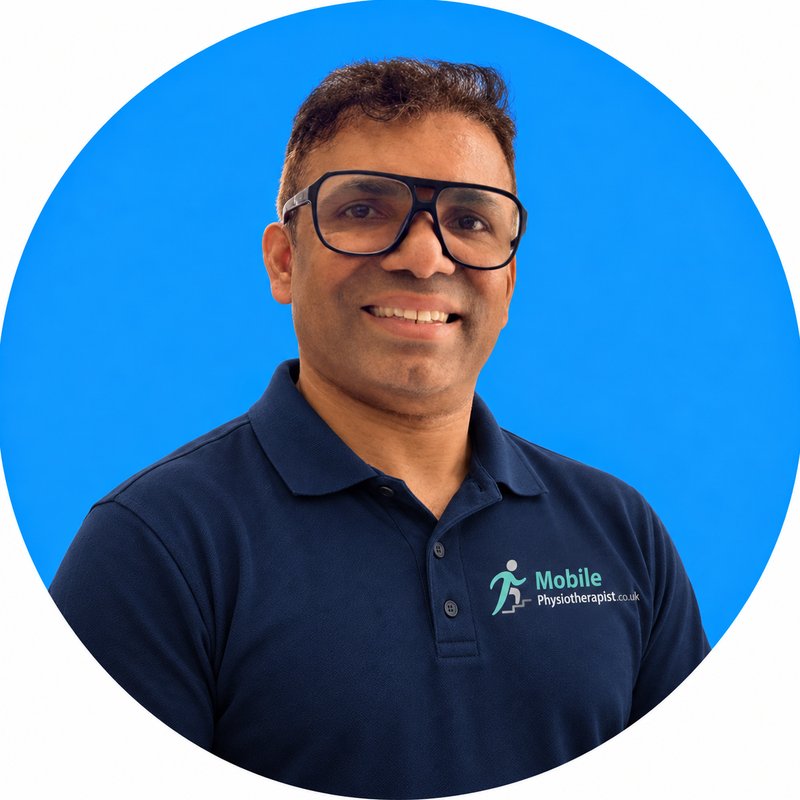
About Raj and the My Rehab at Home team
Rajan Kurian (HCPC PH113871) founded My Rehab at Home, a team of five physiotherapists who visit people at home across Gloucester, Cheltenham, Stroud, Cirencester, Tewkesbury, Lydney, Yate and across Gloucestershire. Raj also works in the NHS as a First Contact Physiotherapist in GP surgeries and a Senior Physiotherapist in local hospitals. He works with Sophie, Fliss, Anna and Katie, whose interests include falls and balance, recovery after surgery, stroke and neurological conditions, dizziness and rehabilitation after an amputation.
Read Raj's profile or call 01594 203707.
Please mention Mobile Physiotherapist.co.uk when you call.