Rehabilitation After an Amputation: Physiotherapy at Home in Gloucestershire
Published
Local Physiotherapists — Rajan Kurian and the My Rehab at Home team, Gloucestershire
Coming home after losing a leg is a huge change, for you and for the people around you. The house that was easy to get around now has steps, narrow doorways and a bathroom that feels out of reach. Physiotherapy at home helps you take it a step at a time, in the place where you have to manage every day.
The first weeks at home
In the early weeks the focus is on healing well and keeping your body ready for what comes next.
- Look after the wound and the skin. Follow the advice from the hospital, and check the skin every day.
- Keep the swelling down. The limb usually needs to shrink and settle before a prosthesis can fit. The hospital may give you a special sock or a compression garment to help.
- Keep the joints straight. Hips and knees stiffen if they stay bent for long periods. Lying flat on your back, and some time lying on your front if you can, helps. For a below-knee amputation, do not rest the limb on a pillow under the knee, and do not leave it hanging off the edge of the chair.
- Keep moving. Gentle exercises for both legs, your arms and your trunk keep you strong.
Phantom feelings and pain
Most people feel the missing part of the leg for a while: tingling, itching, or the sense that the foot is still there. Some have pain in it. This is very common and is not in your head. Tell your team, because there are treatments that help. Gentle touch and massage of the limb, once the wound has healed, can help too.
Getting about before a prosthesis
Before you have a prosthetic limb, you will move around in a wheelchair, and some people also use a walking frame and hop. The physiotherapist helps you do this safely in your own home:
- moving between bed, wheelchair, chair, toilet and car
- getting through doorways and around furniture
- working out what equipment or changes would make the house easier
- practising what to do if you fall, and how to get up or get help
Look after your other leg
Many amputations are due to diabetes or poor circulation, and the other leg may be at risk too. Check that foot every day, wear well-fitting shoes, and see your GP or podiatrist quickly about any cuts, sores or colour changes. Keeping that leg strong matters, because it does a lot of extra work now.
Getting ready for a prosthetic limb
Your NHS limb centre (the prosthetic service) decides whether a prosthesis is right for you and makes and fits it. The stronger and fitter you are when that happens, the easier learning to walk with it will be. That means strong hips, a strong trunk, good balance on the other leg, and joints that straighten fully.
Walking with a prosthesis at home
The limb centre teaches you the basics. Home is where you put them into practice: your own stairs, the step at the front door, the garden path, the kerb outside, getting in and out of the car. A physiotherapist who visits you at home can practise these with you, build up how far you walk, and help you put the limb on and take it off safely.
Confidence and mood
It is normal to feel low, angry or worried after an amputation. Talk to your GP or your team if it is getting on top of you. Family and carers are welcome at visits, and it helps if they learn how to help without doing everything for you.
Who in the team helps
Katie and Fliss on the My Rehab at Home team both work with people after an amputation. The home visits sit alongside the care from your hospital and limb centre, and do not replace it.
Home visits across Gloucestershire
Home physiotherapy after an amputation is available across Gloucester, Cheltenham, Stroud, Cirencester, Tewkesbury, Lydney, Yate and across Gloucestershire. To stay steady on your feet, read our guide to falls prevention in Gloucestershire, and see strength and mobility rehabilitation in Gloucester.
Book a home visit in Gloucestershire
A free phone call is the easiest place to start — talk through what is going on and check whether home physiotherapy is the right fit. No GP referral is needed.
Please mention Mobile Physiotherapist.co.uk
About Raj and the My Rehab at Home team
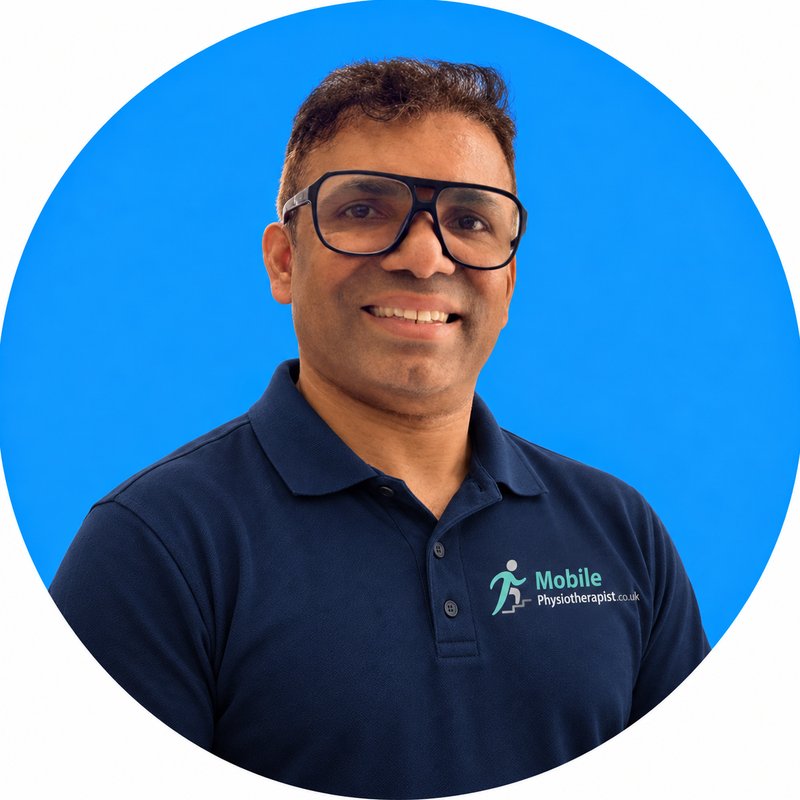
Rajan Kurian (HCPC PH113871) founded My Rehab at Home, a team of five physiotherapists who visit people at home across Gloucester, Cheltenham, Stroud, Cirencester, Tewkesbury, Lydney, Yate and across Gloucestershire. Raj also works in the NHS as a First Contact Physiotherapist in GP surgeries and a Senior Physiotherapist in local hospitals. He works with Sophie, Fliss, Anna and Katie, whose interests include falls and balance, recovery after surgery, stroke and neurological conditions, vertigo and dizziness, jaw (TMJ) problems and rehabilitation after an amputation.
Read Raj's profile or call 01594 203707.
Please mention Mobile Physiotherapist.co.uk when you call.