Stroke Rehabilitation at Home in Warwickshire
Published
Local Physiotherapist — Louis McKenna, Warwickshire
The hardest part of stroke recovery is often not the hospital. It is the week the NHS rehabilitation team signs you off, you are home, you are better than you were but not back to yourself, and nobody is coming on Tuesday any more. That is the point most people start looking for private physiotherapy.
Recovery does not stop at six months
People are often told, or infer, that whatever they have regained by six months is what they keep. That is a misreading of how services are organised rather than a fact about the brain.
Recovery is fastest in the first weeks and months, which is true and is why early rehabilitation is pushed so hard. But improvement in walking speed, endurance, balance and arm function has been shown well beyond a year, in people who keep training. What plateaus reliably is not the brain. It is the amount of therapy being delivered.
The thing that matters most is repetition
If there is one finding that dominates stroke rehabilitation research, it is dose. The number of meaningful repetitions of a task is closely tied to how much function returns, and the numbers achieved in ordinary therapy are typically far below the numbers used in studies that produce real change.
That has a blunt implication. A physiotherapist visiting once a week is not the treatment. What you do on the other six days is the treatment, and the visit exists to make sure it is the right thing, done well enough to count, and progressed when it gets easy.
What home rehabilitation works on
- Walking — not just whether you can, but how far, how fast, over what surfaces, and whether you can do it while carrying something or talking to somebody
- Balance and falls — challenged deliberately, because balance that is never tested does not improve
- The affected arm and hand — the part most often given up on, and the part where repetition matters most
- Getting up from the floor — worth practising before you need it
- Stairs — your stairs, with your bannister on the side it is actually on
- Stamina — fatigue after stroke is real and is often what limits people rather than weakness
Spasticity and shoulder pain
Muscles on the affected side can become tight and overactive, which pulls joints into awkward positions and makes movement harder. Stretching, positioning and the right kind of active work all help, and where spasticity is significant your team may consider botulinum toxin, with physiotherapy afterwards to use the window it opens.
Shoulder pain on the affected side is common and is worth taking seriously early. A weak shoulder that is not supported properly can be injured by ordinary handling, including by well-meaning family. Getting the positioning and the lifting right protects it.
Goals have to be yours
"Getting back to normal" cannot be measured, so it cannot tell you whether anything is working. "Walk to the end of the road and back", "get up the stairs without the second bannister", "hold a cup in my left hand", "get out to the garden" — those can, and they are what a plan should be built around.
Write three of them down at the first appointment and rate each out of ten. Rate them again a month later. It takes two minutes and it is the most honest progress report you will get.
When two physiotherapists are better than one
Most visits are made by one physiotherapist, and for most people that is all that is needed. But where somebody is hard to move safely on their own — heavier to support, very unsteady, or newly home from hospital and not yet confident — a visit can be made by two. It means the work can be done properly instead of cautiously, and it is often the difference between practising standing up and not attempting it at all.
It costs more and it is not needed forever. Ask on the free phone call and you will get an honest answer about whether it applies to you.
Where to get help in Warwickshire
Ask your GP or stroke team what NHS community neurological rehabilitation is available to you, and about the Stroke Association's local support, before you spend anything. Private home physiotherapy is an alternative when the NHS block has finished, or an addition when you want more repetitions than a service can offer.
Home physiotherapy across Warwickshire
Stroke rehabilitation at home is available across Rugby, Nuneaton, Warwick, Leamington Spa, Stratford-upon-Avon and across Warwickshire.
Book a home visit in Warwickshire
A free phone enquiry is the easiest place to start — talk through what is going on and check whether home physiotherapy is the right fit. No GP referral is needed.
Please mention Mobile Physiotherapist.co.uk
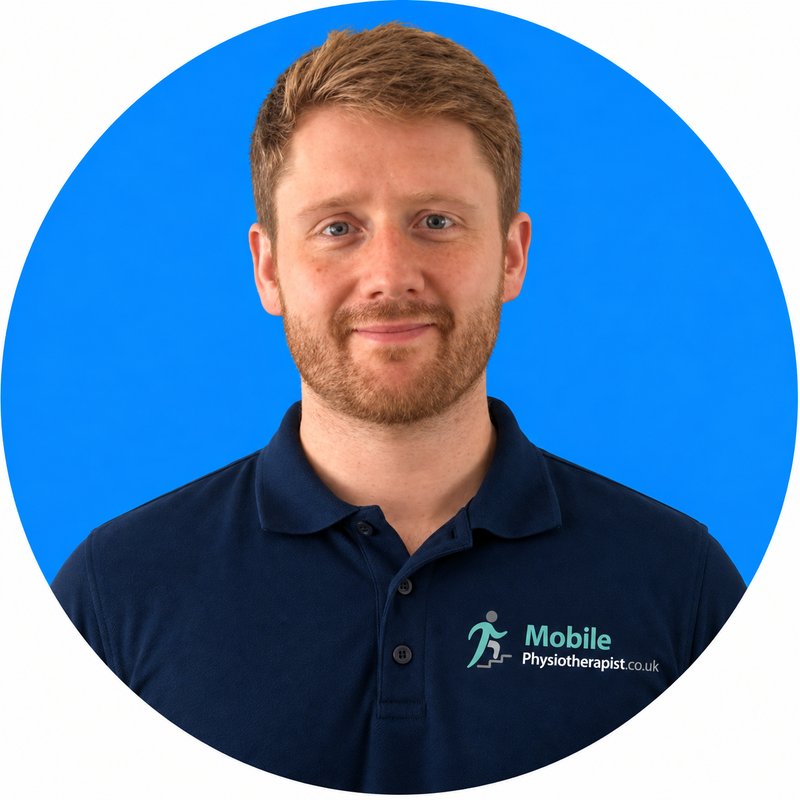
About Louis McKenna
Louis McKenna is a mobile physiotherapist (MCSP, HCPC PH124187) who visits people in their own homes across Rugby, Nuneaton, Warwick, Leamington Spa and across Warwickshire. He runs an independent practice, A&M Physiotherapy, alongside fellow physiotherapist Tom Arnold (HCPC PH125635), and A&M can also offer appointments with two physiotherapists where additional support is needed. Much of his work is neurological rehabilitation, and helping people regain strength, mobility and confidence after a stroke, operation, fall or stay in hospital.
Read Louis's profile or call 07402 961786.
Please mention Mobile Physiotherapist.co.uk when you call.