Stroke Rehabilitation at Home in Gwent
Published
Local Physiotherapists — Rajan Kurian and the My Rehab at Home team, Gwent
After a stroke, coming home is a big step. It is also when much of the real work of recovery happens. Walking to the kitchen, getting up the stairs, using a weak hand to make a cup of tea: these are the things that matter, and home is the best place to practise them.
How recovery after a stroke works
The brain can learn new ways of doing things after a stroke. The more you practise a movement, the more it is strengthened. That is why rehabilitation is mostly about doing things, over and over, in a way that is just hard enough.
The fastest progress is usually in the first three to six months. But improvement can carry on for a long time after that, often for years. It is never too late to work on something that matters to you.
What NHS care you may have
In Gwent, care after a stroke comes from the Aneurin Bevan University Health Board. Many people get some therapy at home from a community or early discharge team when they first leave hospital. That help is often for a set time. Private home physiotherapy can carry on when it ends, or add extra sessions alongside it.
What home physiotherapy works on
- Walking – indoors first, then outside, on slopes, kerbs and uneven ground
- Balance – standing, turning and reaching without losing your footing
- Getting in and out of bed, chairs, the bath, the shower and the car
- Stairs, including the safest way to manage them
- The arm and hand – using them in everyday tasks, not just exercises
- Stiffness and spasm in the muscles, and keeping joints moving
- A painful shoulder, which is common on the weak side
- A dropped foot that catches when you walk
- Falls – reducing the risk, and knowing how to get up or get help
Practice between visits
A visit once or twice a week is not enough on its own. What makes the difference is practice every day. The physiotherapist will give you a short, clear set of things to do, built into your normal day: standing up from your chair five times before each meal, for example, or using your weaker hand to turn the taps. Family can help, once they are shown how.
Tiredness and mood
Feeling very tired is one of the most common problems after a stroke, and it is easy to underestimate. Pacing helps: short bursts of activity with rest in between, and the hardest things at the time of day you feel best. Low mood and worry are common too. Mention them to your GP or your team, because they can be helped.
Help for carers
Carers are welcome at visits. The physiotherapist can show you how to help with moving and walking safely, without hurting your own back, and how to encourage without taking over.
Why home is the right place
Travelling to a clinic is tiring after a stroke, and that tiredness eats into the session. At home, the work is done in the real place: your stairs, your bathroom, your kitchen, your garden path. It is easier to see what is hard and to fix it.
Sophie and Fliss on the My Rehab at Home team both work with people after a stroke and with other neurological conditions.
Know the signs of another stroke
Remember FAST: Face drooping, Arm weakness, Speech problems, Time to call 999. Call straight away, even if the signs go.
Stroke rehabilitation across Gwent
Home visits after a stroke are available across Newport, Cwmbran, Pontypool, Abergavenny, Monmouth, Chepstow, Ebbw Vale and across Gwent. You can read more about stroke rehabilitation in Newport, Pontypool and Ebbw Vale.
Book a home visit in Gwent
A free phone call is the easiest place to start — talk through what is going on and check whether home physiotherapy is the right fit. No GP referral is needed.
Please mention Mobile Physiotherapist.co.uk
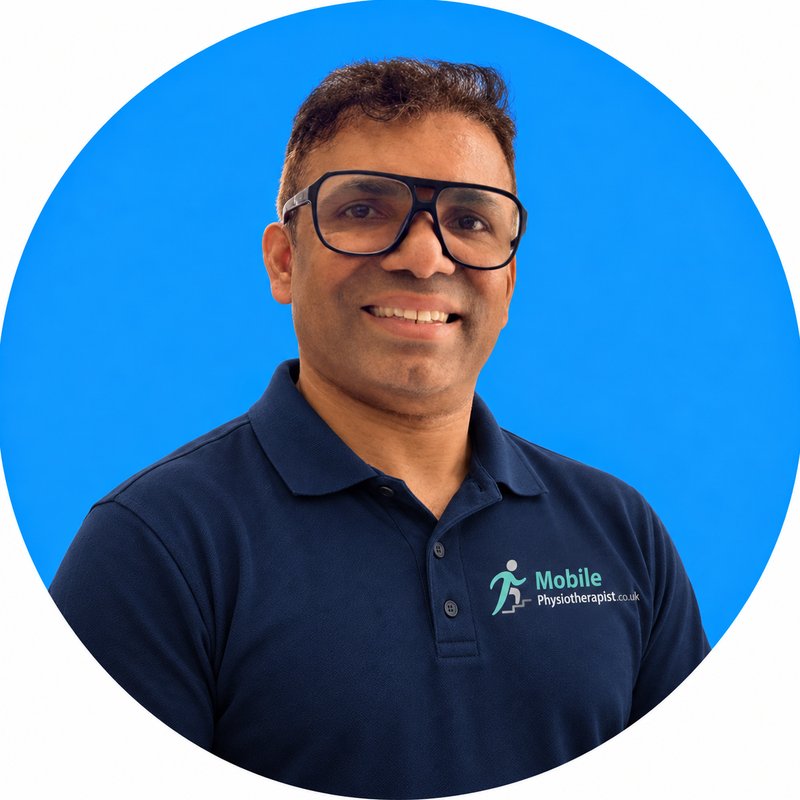
About Raj and the My Rehab at Home team
Rajan Kurian (HCPC PH113871) founded My Rehab at Home, a team of five physiotherapists who visit people at home across Newport, Cwmbran, Pontypool, Abergavenny, Monmouth, Chepstow, Ebbw Vale and across Gwent. Raj also works in the NHS as a First Contact Physiotherapist in GP surgeries and a Senior Physiotherapist in local hospitals. He works with Sophie, Fliss, Anna and Katie, whose interests include falls and balance, recovery after surgery, stroke and neurological conditions, vertigo and dizziness, jaw (TMJ) problems and rehabilitation after an amputation.
Read Raj's profile or call 01594 203707.
Please mention Mobile Physiotherapist.co.uk when you call.