Multiple Sclerosis: Physiotherapy at Home in Warwickshire
Published
Local Physiotherapist — Louis McKenna, Warwickshire
Multiple sclerosis does not follow a straight line, and that is what makes rehabilitation for it different. The aim is not to fix something and finish. It is to hold on to as much walking, balance and independence as possible, for as long as possible, and to have a plan that changes when the condition does.
What physiotherapy is actually for in MS
Physiotherapy does not slow the disease. Nothing in a physiotherapist's hands changes what is happening in the nervous system, and anybody who implies otherwise should be treated with suspicion.
What it does do is change what you can manage with the nervous system you have. Strength, balance, walking efficiency, transfers, fatigue management and the practical business of getting round your own house are all trainable, and they are trainable at every stage. People with MS who exercise regularly walk better, fall less and report better quality of life than those who do not. That is a large and reasonably consistent body of evidence.
Fatigue is usually the first thing to sort out
Fatigue affects most people with MS and it is not ordinary tiredness. It arrives disproportionately, it is not fixed by a good night's sleep, and it is the single biggest reason people stop doing things.
The instinct is to rest more, and up to a point that is right. But complete rest costs you conditioning, and lost conditioning makes everything more tiring, which is a loop worth interrupting early. The practical approach is pacing: working out how much you can do before you pay for it, breaking activity into shorter bouts, and spending your best hours on the things that matter to you rather than on the hoovering.
Exercise, done at the right dose, reduces MS fatigue rather than adding to it. The dose is the whole argument, and it is what a physiotherapist is for.
Heat sensitivity, and why it is not a setback
Many people with MS find symptoms worsen when they get hot — in a warm room, in a bath, or during exercise. It can be alarming, because vision blurs or a leg becomes noticeably weaker.
It is temporary. Nerve conduction is affected by temperature, and it recovers as you cool down. It is not a relapse and it is not damage. Knowing that is the difference between avoiding exercise altogether and exercising sensibly: shorter bouts, a cool room, a fan, cold drinks, and swimming if you have access to a pool.
Walking and balance
Walking changes in MS for several reasons at once, and they need separating before anything useful can be done. Weakness in a particular muscle group is a different problem from spasticity, which is a different problem again from poor balance or from foot drop. A proper assessment works out which of them is driving your particular pattern.
Depending on what it finds, the plan might involve targeted strengthening, stretching and positioning for spasticity, balance work that is genuinely challenging rather than comfortable, or a discussion about a stick, a frame or an ankle-foot orthosis. Equipment is not a defeat. A device that lets you walk further and more safely buys you more activity, not less.
Exercise when the condition fluctuates
A programme written for a good week is useless in a bad one, and being unable to complete it makes people abandon the whole thing. The fix is to have the plan written at two or three levels from the start: what you do on a good day, what you do on an average day, and the short version you can still manage on a bad one. Something on a bad day is far better than nothing, and it keeps the habit alive.
During a relapse, the priority changes. Rehabilitation after a relapse usually recovers more function than people expect, and it is worth restarting deliberately rather than waiting to feel ready.
What a home visit adds
Getting to a clinic costs energy that people with MS do not have to spare, and arriving exhausted means the appointment is spent recovering rather than working. That alone is a good reason for home visits.
The bigger reason is that the problems are domestic. Your stairs, your bathroom, your bed, the step at your back door, the chair you struggle out of at the end of the day. Those are the things worth practising, and they can only be practised where they are.
When two physiotherapists are better than one
Most visits are made by one physiotherapist, and for most people that is all that is needed. But where somebody is hard to move safely on their own — heavier to support, very unsteady, or newly home from hospital and not yet confident — a visit can be made by two. It means the work can be done properly instead of cautiously, and it is often the difference between practising standing up and not attempting it at all.
It costs more and it is not needed forever. Ask on the free phone call and you will get an honest answer about whether it applies to you.
How this fits with NHS care
If you are under a neurologist or an MS nurse, keep them. Private home physiotherapy sits alongside NHS care rather than replacing it, and a good physiotherapist will want to know what your team has advised. Warwickshire has NHS neurological rehabilitation and community services, and there is an MS therapy centre in Coventry offering physiotherapy and other support, so it is worth asking what you are already entitled to before you spend anything.
Home physiotherapy across Warwickshire
Home visits for multiple sclerosis are available across Rugby, Nuneaton, Warwick, Leamington Spa, Stratford-upon-Avon and across Warwickshire.
Book a home visit in Warwickshire
A free phone enquiry is the easiest place to start — talk through what is going on and check whether home physiotherapy is the right fit. No GP referral is needed.
Please mention Mobile Physiotherapist.co.uk
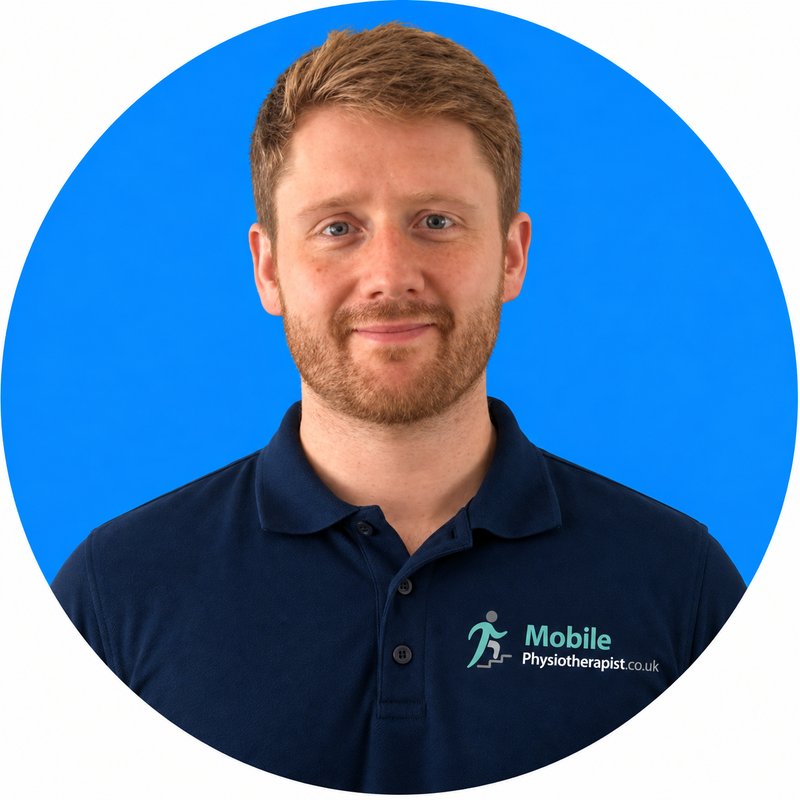
About Louis McKenna
Louis McKenna is a mobile physiotherapist (MCSP, HCPC PH124187) who visits people in their own homes across Rugby, Nuneaton, Warwick, Leamington Spa and across Warwickshire. He runs an independent practice, A&M Physiotherapy, alongside fellow physiotherapist Tom Arnold (HCPC PH125635), and A&M can also offer appointments with two physiotherapists where additional support is needed. Much of his work is neurological rehabilitation, and helping people regain strength, mobility and confidence after a stroke, operation, fall or stay in hospital.
Read Louis's profile or call 07402 961786.
Please mention Mobile Physiotherapist.co.uk when you call.