Jaw Pain and TMJ Problems: Physiotherapy in Bristol, Bath and North Somerset
Published
Local Physiotherapists — Rajan Kurian and the My Rehab at Home team, Bristol, Bath and North Somerset
Jaw pain can make eating, talking and even yawning hard work. It is often called a TMJ problem, after the jaw joint. It is common, it is rarely serious, and most people get better with simple care. Physiotherapy is one of the most useful treatments.
What is a TMJ problem?
TMJ stands for temporomandibular joint: the joint where your lower jaw meets your skull, just in front of each ear. "TMJ problem" (or TMD, for temporomandibular disorder) is a catch-all name for pain and trouble with the jaw joint and the muscles that move it.
There are three broad kinds, and you can have more than one:
- Muscle pain – the most common. The chewing muscles are tight, tender and tired, often from clenching or grinding.
- A problem inside the joint – a small disc of cartilage in the joint can slip out of place, causing clicking, or sometimes a jaw that catches or gets stuck.
- Arthritis – wear in the joint, which is more common as we get older.
Common signs
- Pain in the jaw, the face, in front of the ear or at the temples
- Clicking, popping or a grating feeling
- Not being able to open your mouth fully
- A jaw that catches or locks
- Earache, or a full feeling in the ear, with nothing wrong in the ear
- Headaches, and a stiff neck
How is it diagnosed?
Usually by talking it through and a careful examination: how the jaw opens, where it hurts, what clicks, and how the neck is moving. Scans are not usually needed. If anything suggests a different cause, the physiotherapist will send you back to your GP or dentist.
Will it get better?
For most people, yes. Many TMJ problems settle with simple care over weeks or a few months. The best first steps are the gentle ones: understanding the problem, looking after the jaw, exercises and hands-on treatment. Treatments that cannot be undone, such as changing the bite, are not a first step.
What does physiotherapy involve?
Understanding the problem. Knowing what is going on, and that it is not dangerous, helps a lot. So does knowing what makes it worse.
Hands-on treatment. Gentle massage and release of the tight chewing muscles, and gentle movement of the joint, to ease pain and help it move better.
Exercises. Short, gentle exercises, done slowly, often in front of a mirror. For example: resting the tip of your tongue on the roof of your mouth and opening only as far as you can while it stays there, so the jaw opens in a straight line without clicking. The physiotherapist will choose the right ones for you and show you how.
The neck and posture. The neck and jaw work closely together. Easing a stiff neck, and changing how you sit at a desk or on the sofa, often helps the jaw.
Habits and stress. Clenching, grinding, chewing gum, biting nails, and stress all play a part. Learning to keep the teeth apart and the jaw relaxed is one of the most useful things you can do.
Looking after your jaw day to day
- Lips together, teeth apart, tongue resting on the roof of the mouth
- Softer food for a while, cut into small pieces
- No chewing gum
- Support your chin when you yawn
- Warmth on sore muscles
Older people and dentures
TMJ problems are not only a young person's complaint. Dentures that no longer fit well, missing teeth and arthritis can all cause jaw pain in later life. If you wear dentures, ask your dentist to check the fit as well.
When to get help quickly
- See a dentist or doctor quickly if your jaw is locked open or shut, or if you have swelling, a high temperature or numbness in the face.
- Call 999 if jaw pain comes with chest pain, breathlessness or sweating, as it can be a sign of a heart problem.
Who in the team helps
Anna on the My Rehab at Home team has a special interest in jaw (TMJ) problems. She is also a massage therapist, which suits the hands-on side of the treatment.
Jaw pain treatment across Bristol, Bath and North Somerset
Home visits for jaw pain and TMJ problems are available across Clifton, Henleaze, Bath, Keynsham, Weston-super-Mare, Clevedon, Portishead and across Bristol, Bath and North Somerset. You can read more about jaw pain treatment in Clifton, Bath and Weston-super-Mare.
Book a home visit in Bristol, Bath and North Somerset
A free phone call is the easiest place to start — talk through what is going on and check whether home physiotherapy is the right fit. No GP referral is needed.
Please mention Mobile Physiotherapist.co.uk
About Raj and the My Rehab at Home team
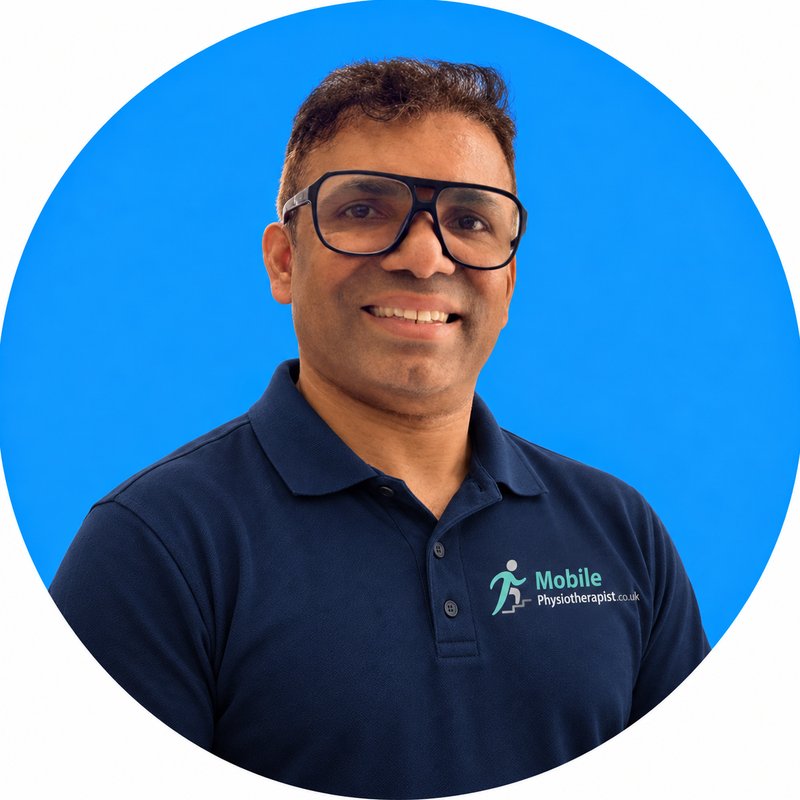
Rajan Kurian (HCPC PH113871) founded My Rehab at Home, a team of five physiotherapists who visit people at home across Clifton, Henleaze, Bath, Keynsham, Weston-super-Mare, Clevedon, Portishead and across Bristol, Bath and North Somerset. Raj also works in the NHS as a First Contact Physiotherapist in GP surgeries and a Senior Physiotherapist in local hospitals. He works with Sophie, Fliss, Anna and Katie, whose interests include falls and balance, recovery after surgery, stroke and neurological conditions, vertigo and dizziness, jaw (TMJ) problems and rehabilitation after an amputation.
Read Raj's profile or call 01594 203707.
Please mention Mobile Physiotherapist.co.uk when you call.