Recovering From a Hip or Knee Replacement at Home: Bristol, Bath and North Somerset
Published
Local Physiotherapists — Rajan Kurian and the My Rehab at Home team, Bristol, Bath and North Somerset
Most people go home a day or two after a hip or knee replacement. That is good news, but it means most of the recovery happens at home, often with not much help. The work you put in over the first few weeks makes a big difference to how well the new joint works.
Before you leave hospital
Across the area, most NHS joint replacements are done at Southmead Hospital in Bristol, the Royal United Hospital in Bath, or Weston General Hospital. The hospital physiotherapist will usually get you up and walking, check you can manage stairs, and give you a sheet of exercises. Keep it, and follow any advice your surgical team gives you. It always comes first.
The first six weeks
Pain. Some pain is normal. Take your painkillers as advised, and time them so they are working when you do your exercises.
Swelling. The leg often swells, especially by the end of the day. Rest with the leg up, and use a cold pack wrapped in a towel if the hospital has said you can.
Exercises. Little and often, several times a day, works better than one long session. Knees in particular need steady work to bend and to straighten fully, and that is much harder to get back later.
Walking aids. Most people go from a frame or two crutches, to one crutch or a stick, to nothing. Move on when the physiotherapist says you are ready, not just because you feel you should.
Sleep. It is often poor for a few weeks. Ask what position is best for your new joint.
Stairs
Hold the rail. Going up, step up with your good leg first. Coming down, step down with the operated leg first, with the crutch. The easy way to remember it: up with the good, down with the bad.
Everyday things
- Chairs – a firm chair with arms is easier. Very low, soft sofas are hard work at first.
- The car – sit down on the seat first, then swing your legs in together. Most people can drive again at about six weeks, but check with your surgeon and your insurer first.
- Washing and dressing – long-handled aids and a shower seat can help in the early weeks.
Warning signs
- Call the hospital or your GP straight away if your calf becomes painful, hot or swollen, if the wound becomes red, hot or leaks, or if you have a high temperature.
- Call 999 if you have sudden chest pain or become suddenly short of breath.
How home physiotherapy helps
NHS physiotherapy after a joint replacement is often a short course, and it may mean getting to a clinic before you can drive. Home visits mean you can start straight away, without travelling. The physiotherapist can:
- check the joint is bending and straightening as it should, and push on if it is lagging
- move your exercises on as you get stronger, so you keep improving
- practise your own stairs, chairs, bath, car and garden step
- help you swap the frame for crutches, and the crutches for a stick, safely
- help you get back to the things you had the operation for: walking the dog, the garden, the shops
Katie on the My Rehab at Home team works with people after orthopaedic surgery, and recovery after an operation is one of Raj's main interests.
Home visits across Bristol, Bath and North Somerset
Home physiotherapy after a hip or knee replacement is available across Clifton, Henleaze, Bath, Keynsham, Weston-super-Mare, Clevedon, Portishead and across Bristol, Bath and North Somerset. You can read more about hip and knee replacement rehab in Bath, Clevedon and Weston-super-Mare.
Book a home visit in Bristol, Bath and North Somerset
A free phone call is the easiest place to start — talk through what is going on and check whether home physiotherapy is the right fit. No GP referral is needed.
Please mention Mobile Physiotherapist.co.uk
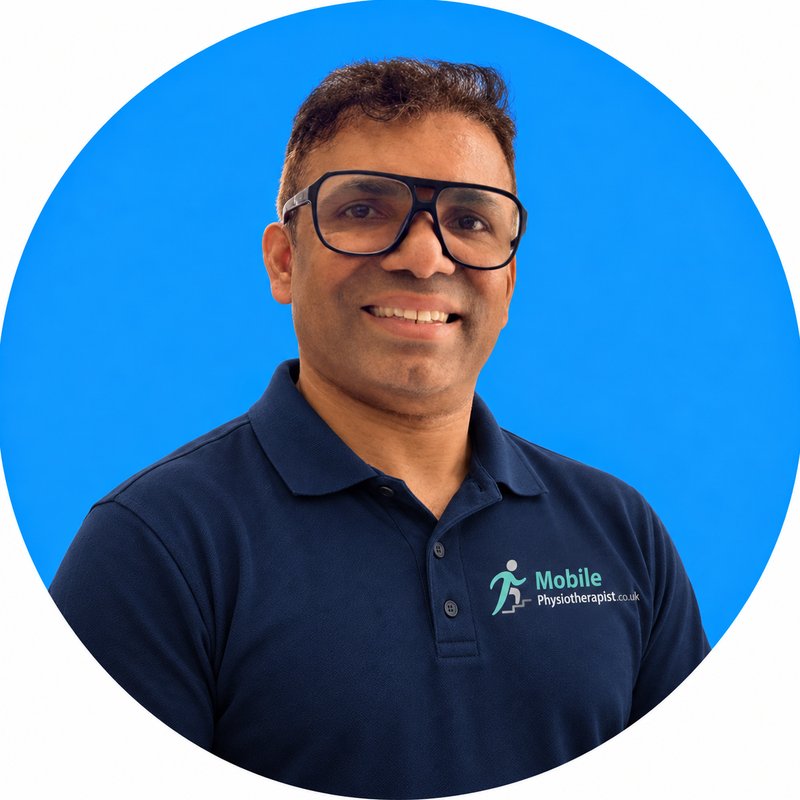
About Raj and the My Rehab at Home team
Rajan Kurian (HCPC PH113871) founded My Rehab at Home, a team of five physiotherapists who visit people at home across Clifton, Henleaze, Bath, Keynsham, Weston-super-Mare, Clevedon, Portishead and across Bristol, Bath and North Somerset. Raj also works in the NHS as a First Contact Physiotherapist in GP surgeries and a Senior Physiotherapist in local hospitals. He works with Sophie, Fliss, Anna and Katie, whose interests include falls and balance, recovery after surgery, stroke and neurological conditions, vertigo and dizziness, jaw (TMJ) problems and rehabilitation after an amputation.
Read Raj's profile or call 01594 203707.
Please mention Mobile Physiotherapist.co.uk when you call.