What Is Frailty, and Can It Be Turned Around?
Published
Local Physiotherapist — Steve McLaren, Tyne and Wear
Frailty is a word doctors use a lot and explain very little. It often turns up on a hospital letter, and families take it to mean that nothing more can be done. That is usually wrong. Frailty describes how much reserve someone has left, and reserve can often be built back up.
What frailty actually means
Frailty is not the same as being old. Plenty of people in their nineties are not frail, and some people in their sixties are. It describes how well the body copes with a knock — a chest infection, a fall, a new tablet, a few days in bed.
A fit person bounces back from those things. Someone who is frail does not. A small illness leads to a big drop: they stop walking as far, become muddled, fall, or end up in hospital. The problem is not the infection itself. It is that there was very little spare capacity to absorb it.
What are the signs?
The most widely used description looks for five things:
- Losing weight without trying
- Feeling worn out much of the time
- Weak grip and weak legs
- Walking slowly
- Doing much less than before
Having three or more of these usually means frailty. Having one or two is often called "pre-frailty", and that is the best time of all to act, because it is the easiest point to turn things around.
In everyday life it often shows up as a string of small changes: needing the arms to get out of a chair, holding onto the furniture, giving up the walk to the shop, stopping going upstairs to bed, or a first fall.
How hospital staff use it
Hospitals score frailty on a simple scale from 1, very fit, to 9, terminally ill. The score helps staff decide who is likely to struggle on a busy ward and who might recover better at home. More and more, older people who come into A&E are looked at by a team whose job is to spot frailty early and, where it is safe, get the right help to them at home rather than admit them.
If a letter mentions a frailty score, it is a snapshot of that day, often while unwell. It is not a life sentence.
Can frailty be reversed?
Often, yes, at least in part. The single most useful thing is exercise — and specifically, exercise that makes the leg muscles work hard and challenges balance. Strength can be built at any age. People in their eighties and nineties who do regular strength work get measurably stronger, walk faster and fall less.
The other pieces matter too:
- Eating enough, especially protein. Muscle cannot be built on tea and toast. Small, regular meals with protein in them make exercise work far better.
- A medication review. Some tablets make people drowsy, dizzy or unsteady, and the more tablets someone takes the more this adds up. Ask the GP or pharmacist. Do not stop anything on your own.
- Staying connected. Loneliness and low mood lead to doing less, and doing less leads to frailty. Getting out, even a little, counts.
What a physiotherapist does
At home, a physiotherapist will measure where someone is starting from: how many times they can stand up from a chair, how long they can balance, how fast and how steadily they walk. Those numbers give a baseline to beat.
Then comes a short, regular programme built into the day. Standing up from the chair ten times during the adverts. Heel raises at the kitchen worktop. Marching on the spot. Walking a bit further each week. Nothing needs special kit, but it does need to be hard enough to count, and to get a little harder as the person gets stronger.
A physiotherapist also looks at the house — the stairs, the bed, the bathroom — and at the fear of falling, which on its own can make someone stop moving.
Why the first weeks home from hospital matter most
Older people lose leg strength quickly in bed. A week or two on a ward can take someone from managing the stairs to not managing them. The weeks straight after coming home are the window where that strength comes back most easily, and also where it is most easily lost for good if nothing is done.
If someone you care for has come home weaker than they went in, that is the time to get help, not months later.
Home physiotherapy across Tyne and Wear
Home visits for frailty, strength and balance are available across North Shields, Tynemouth, Whitley Bay, Newcastle, Gateshead, South Shields, Sunderland and across Tyne and Wear.
Book a home visit in Tyne and Wear
A free phone call is the easiest place to start — talk through what is going on and check whether home physiotherapy is the right fit. No GP referral is needed.
Please mention Mobile Physiotherapist.co.uk
About Steve McLaren
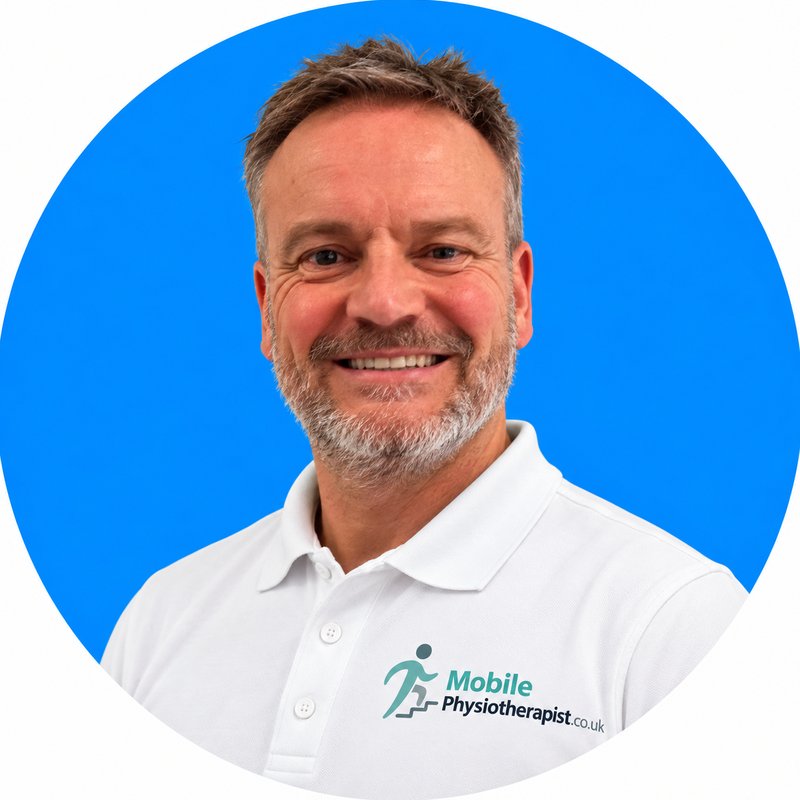
Steve McLaren is a chartered physiotherapist (MCSP, HCPC PH52681) providing home visit physiotherapy across North Shields, Tynemouth, Whitley Bay, Newcastle, Gateshead, South Shields, Sunderland and across Tyne and Wear. He qualified in 1997 and has spent more than 20 years in community rehabilitation, treating people in their own homes. He works in the NHS in Newcastle, in a rapid response team that treats frail older people at home and in the emergency department, and his particular interest is falls prevention. He lives in North Shields.
Read Steve's profile or call 07788 974385.
Please mention Mobile Physiotherapist.co.uk when you call.